dummy.py Validation
What this page checks
This page checks the luminosity of the star and the stellar flux at the planet in the dummy star module, src/proteus/star/dummy.py. The dummy star computes both from the effective temperature and the radius of the star with the Stefan-Boltzmann law. Validation means that a test runs the code on a case with a known right answer and checks the result within a stated tolerance. If this part of the code is wrong, the energy that reaches the planet in a run with the dummy star is wrong. Each case below says why the check exists, what it tests, how we know the right answer and why it matters. A box "Test details" ends each case.
Reference-pinned tests
| Test ID | Reference | What is pinned |
|---|---|---|
test_star::test_calc_star_luminosity_solar |
IAU 2015 Resolution B3, nominal solar luminosity L_sun = 3.828e26 W | Solar Teff and radius yield L_sun via Stefan-Boltzmann law (rel=0.01) |
test_star::test_calc_instellation_earth_like |
IAU 2015 Resolution B3, nominal total solar irradiance S_0 = 1361 W/m^2 | Earth-like planet at 1 AU receives 1361 W/m^2 (rel=0.01) |
Luminosity of the Sun
Why this check exists. The luminosity is \(L = 4 \pi R^2 \sigma T_\mathrm{eff}^4\), with \(R\) the stellar radius, \(T_\mathrm{eff}\) the effective temperature and \(\sigma\) the Stefan-Boltzmann constant. A wrong power of the temperature, a radius in km where m belongs, or a constant in cgs where SI belongs gives a wrong luminosity without an error message.
What it tests. calc_star_luminosity with the solar effective temperature and radius must return the nominal solar luminosity. A range check, \(10^{26} < L < 10^{27}\) W, rejects a radius in km (which gives about 3.85e20 W) and a cgs-SI slip on \(\sigma\) (a factor of 1000).
How we know the right answer. IAU 2015 Resolution B3 defines the nominal solar luminosity as 3.828e26 W.
Why it matters. With star.module = 'dummy', dummy.py takes the stellar luminosity from calc_star_luminosity, and so does the orbit wrapper for orbit.instellation_method = 'inst'.
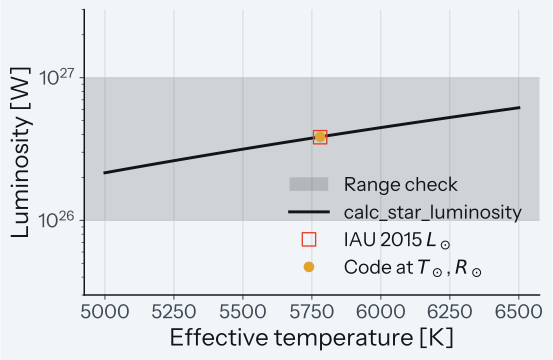
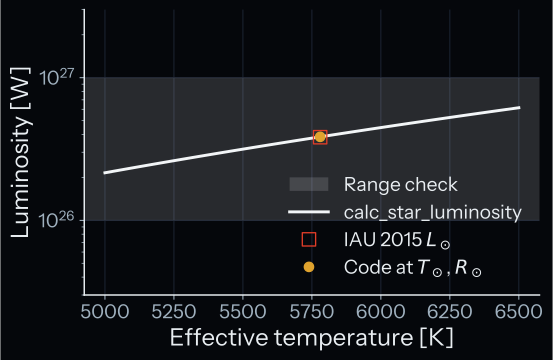
How to read the plot. The x-axis is the effective temperature and the y-axis the luminosity on a log scale, at the solar radius. The line is calc_star_luminosity (context). The filled circle is the asserted code value at the solar temperature and radius. The hollow square is the nominal solar luminosity of the International Astronomical Union (IAU 2015); the test allows 1 %, too little to see. The grey band is the asserted range check, \(10^{26}\) to \(10^{27}\) W. A pass means that the circle sits in the square and in the band.
Test details
- Reference: IAU 2015 Resolution B3, nominal solar luminosity L_sun = 3.828e26 W.
- Tolerance: relative 0.01; range check 1e26 to 1e27 W.
- Test id:
tests/star/test_star.py::test_calc_star_luminosity_solar - Command:
pytest -m reference_pinned tests/star/test_star.py --validation-plots
Stellar flux at 1 AU
Why this check exists. The flux at the planet is the luminosity spread over a sphere with the radius of the orbit. A distance in km where m belongs, or a radius unit slip, changes the flux by large factors without an error message.
What it tests. calc_instellation with the solar effective temperature and radius at 1 AU (astronomical unit) must return the nominal total solar irradiance. A range check, 1000 to 2000 W/m\(^2\), rejects a radius in km (about 1.4e-3 W/m\(^2\)) and an AU in km (about 1e6 times the right value).
How we know the right answer. IAU 2015 Resolution B3 defines the nominal total solar irradiance as 1361 W/m\(^2\).
Why it matters. With star.module = 'dummy', update_instellation takes the stellar flux at the planet from calc_instellation.
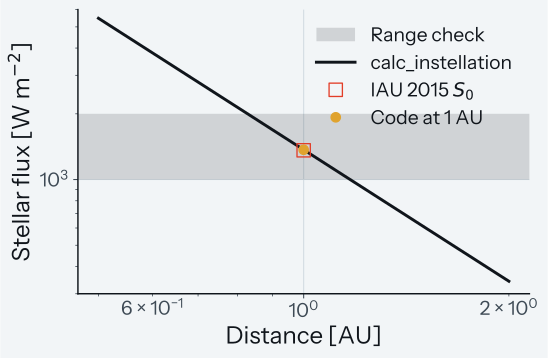
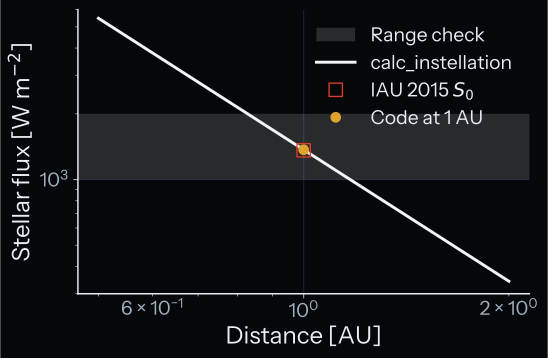
How to read the plot. The x-axis is the distance from the star and the y-axis the stellar flux, both on log scales. The line is calc_instellation for the solar temperature and radius (context). The filled circle is the asserted code value at 1 AU, the astronomical unit. The hollow square is the nominal total solar irradiance of the International Astronomical Union (IAU 2015); the test allows 1 %. The grey band is the asserted range check, 1000 to 2000 W/m\(^2\). A pass means that the circle sits in the square and in the band.
Test details
- Reference: IAU 2015 Resolution B3, nominal total solar irradiance S_0 = 1361 W/m^2.
- Tolerance: relative 0.01; range check 1e3 to 2e3 W/m^2.
- Test id:
tests/star/test_star.py::test_calc_instellation_earth_like - Command:
pytest -m reference_pinned tests/star/test_star.py --validation-plots
Last verified
2026-05-24