Earth analogue
This tutorial simulates the thermal and atmospheric evolution of an Earth-mass planet at 1 AU from a Sun-like star, reproducing the nominal Earth case from the CHILI intercomparison 1.
It uses the production-quality module combination: Aragog (interior energetics), Zalmoxis (interior structure), CALLIOPE (outgassing), and AGNI (atmosphere climate).
Prerequisites
- Full PROTEUS installation with AGNI and SOCRATES compiled
FWL_DATAandRAD_DIRenvironment variables set- Spectral files downloaded (
proteus get spectral -n Dayspring -b 48) - Solar spectrum downloaded (
proteus get stellar) - Interior data downloaded, including the PALEOS EOS tables for the
structure solver
(
proteus get interiordata --config-path input/tutorials/tutorial_earth.toml)
Reference data is also fetched automatically when proteus start runs
without the --offline flag, so the download commands above are only
required for offline use.
Physical setup
This case follows Table 2 of the CHILI protocol paper:
| Parameter | Value |
|---|---|
| Planet mass | 1 M\(_\oplus\) |
| Core mass fraction | 0.325 |
| Stellar mass | 1 M\(_\odot\) |
| Starting stellar age | 50 Myr |
| Semi-major axis | 1 AU |
| Bond albedo | 0.1 |
| Oxygen fugacity | IW+4 |
| Hydrogen inventory | 4.7 \(\times\) 10\(^{20}\) kg (3 Earth oceans H\(_2\)O) |
| Carbon inventory | 2.73 \(\times\) 10\(^{20}\) kg (10\(^{21}\) kg CO\(_2\)) |
| Initial thermal state | Fully molten |
| Termination | Melt fraction \(\Phi\) < 5% |
The planet starts fully molten and cools through a magma ocean stage. Volatiles partition between the atmosphere and silicate melt as the mantle solidifies. The atmosphere is solved at each timestep using correlated-k radiative transfer (AGNI). Atmospheric escape is energy-limited (ZEPHYRUS, 30% efficiency).
Running the simulation
conda activate proteus
mkdir -p output/tutorial_earth
nohup proteus start -c input/tutorials/tutorial_earth.toml \
    > /tmp/proteus_earth_launch.log 2>&1 & disown
Add --offline to skip the reference-data check on later runs; the first
run must be able to download any missing data (or download it beforehand,
see the prerequisites above).
Monitor progress with tail -f output/tutorial_earth/proteus_00.log
(the log appears once PROTEUS has initialized).
Runtime
This run takes several hours to overnight depending on hardware. The initial Zalmoxis structure solve costs ~10-20 min, but the rate-limiting stretch is the mushy solidification phase, where the coupled solver takes sub-year timesteps to resolve the interior-atmosphere flux balance while the mantle crystallizes through the melt-fraction range \(\Phi\) = 0.7 to 0.08. The timestep lengthens again during the final approach to the 5% termination.
Configuration
The config at input/tutorials/tutorial_earth.toml sets:
- Star: Sun on Spada 2 tracks starting at 50 Myr. The solar spectrum is used for radiative transfer. Stellar luminosity, radius, and XUV flux evolve with age.
- Interior: Aragog solves the mantle energy equation on an 80-node radial grid using SUNDIALS CVODE with JAX Jacobian. Zalmoxis computes the hydrostatic structure using PALEOS EOS tables.
- Outgassing: CALLIOPE partitions H\(_2\)O, CO\(_2\), H\(_2\), CH\(_4\), and CO between atmosphere and melt at the fO\(_2\) = IW+4 buffer.
- Atmosphere: AGNI solves the radiative-convective equilibrium with Dayspring 48-band correlated-k opacities, a conductive skin layer at the surface, and real-gas corrections.
- Escape: ZEPHYRUS computes energy-limited mass loss at 30% efficiency, distributing the bulk escape rate across elements proportionally.
Results
After the run completes, generate plots:
proteus plot -c input/tutorials/tutorial_earth.toml all
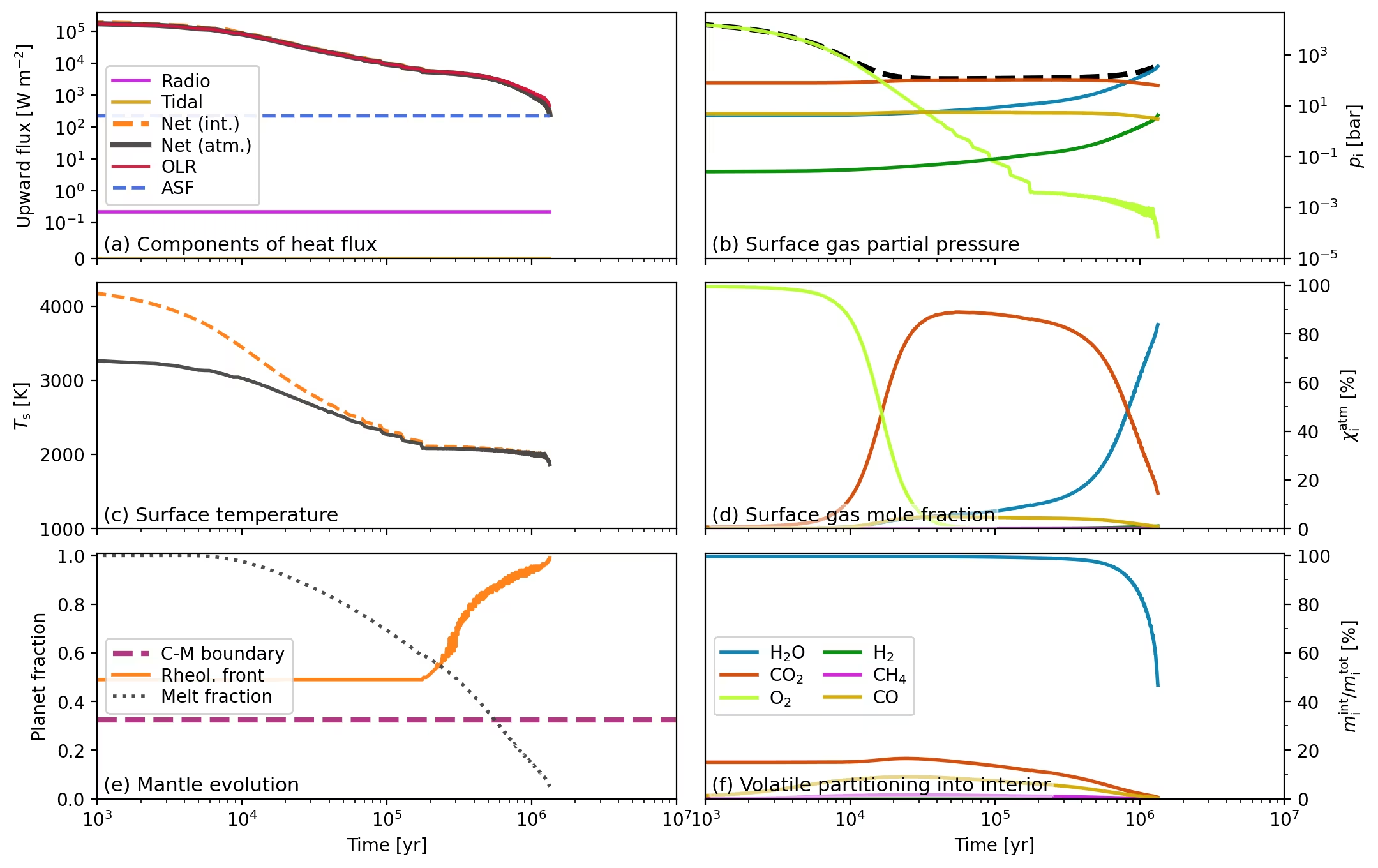
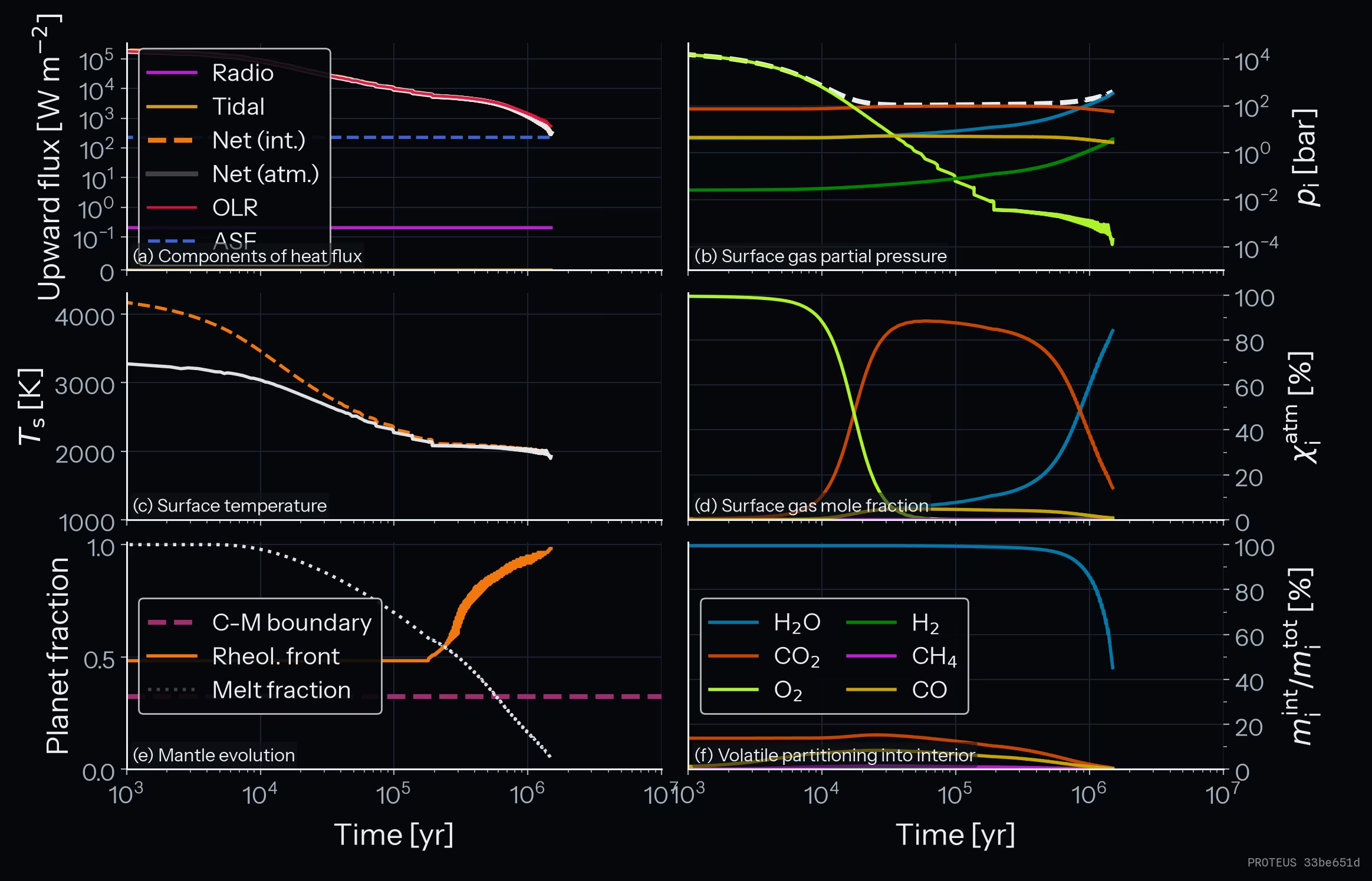
Thermal evolution (a, c)
The planet starts fully molten, with a surface temperature T\(_\mathrm{s}\) \(\approx\) 3300 K and a magma temperature near 4280 K. The magma ocean radiates through a thick atmosphere, with the net interior and atmospheric fluxes reaching a few \(\times\) 10\(^5\) W m\(^{-2}\) initially (a). Radiogenic heating (magenta) provides a constant ~0.2 W m\(^{-2}\) baseline, negligible compared to the interior cooling flux. The absorbed stellar flux (ASF, dashed blue) is ~226 W m\(^{-2}\) at 1 AU (instellation F\(_\mathrm{ins}\) \(\approx\) 1005 W m\(^{-2}\) at 50 Myr, reduced by the geometry factor, Bond albedo, and zenith angle).
The surface temperature (c, solid) decreases from ~3300 K to ~1920 K at the solidus over ~1.5 Myr; the magma temperature (dashed orange) tracks above it, starting near 4280 K. The decline slows around 10\(^5\) yr as the mantle enters the mushy zone and latent heat release buffers the cooling. At solidification the net interior and atmospheric fluxes have fallen to a few hundred W m\(^{-2}\) (OLR ~540 W m\(^{-2}\)), approaching balance with the absorbed stellar flux.
Atmospheric evolution (b, d)
The atmosphere passes through three compositional stages as the mantle solidifies:
-
Superheated initial state (t \(\lesssim\) 10\(^4\) yr): at the fully molten, superheated initial condition the IW+4 oxygen fugacity buffer produces an O\(_2\)-dominated atmosphere (~100 mol%, d) with a total surface pressure of ~2 \(\times\) 10\(^4\) bar (b). This O\(_2\) collapses as the surface cools below ~3000 K, falling from ~2 \(\times\) 10\(^4\) bar to below 10 bar within the first ~3 \(\times\) 10\(^4\) yr and to a negligible partial pressure by ~10\(^5\) yr.
-
CO\(_2\)-dominated phase (~10\(^4\) to ~8 \(\times\) 10\(^5\) yr): as O\(_2\) collapses, CO\(_2\) becomes the dominant species. Its mole fraction peaks near 88% around 6 \(\times\) 10\(^4\) yr, where the partial pressure is ~96 bar; the partial pressure then rises to a broad maximum of ~97 bar near 2 \(\times\) 10\(^5\) yr (b, d). H\(_2\)O begins at only ~4 bar, with nearly all water dissolved in the silicate melt (~99.6% interior at the start, f), and rises through this phase as the crystallizing mantle exsolves it.
-
H\(_2\)O-dominated phase (t > ~8 \(\times\) 10\(^5\) yr): H\(_2\)O overtakes CO\(_2\) in mole fraction around 8.5 \(\times\) 10\(^5\) yr (d) and keeps rising as the melt crystallizes. It dominates the final atmosphere at ~84 mol% (~340 bar), with CO\(_2\) at ~14 mol% (~57 bar). The total surface pressure at solidification is ~403 bar.
CO stays at a few bar throughout (~3-5 bar), while H\(_2\) climbs from below 0.1 bar to ~3.9 bar only as the last volatiles exsolve near solidification; both remain minor, consistent with the oxidizing conditions (IW+4). CH\(_4\) is negligible.
Mantle evolution (e, f)
The Zalmoxis structure solver computes the hydrostatic profile at initialization: R\(_\mathrm{planet}\) = 7.07 Mm (1.11 R\(_\oplus\)), core radius = 3.41 Mm (0.54 R\(_\oplus\), 0.48 of the planet radius), surface gravity = 7.77 m s\(^{-2}\), CMB pressure = 103 GPa, center pressure = 342 GPa.
In (e), the dashed purple line is drawn at the core mass fraction (0.325). The rheological front (orange), defined as the radius where \(\Phi\) = 0.4, starts at the core-mantle boundary in radius (~0.48 of the planet radius, above the mass-fraction reference) and propagates outward as the mantle crystallizes from the base up. The global melt fraction (dotted) decreases from 1.0 to 0.05, at which point the run terminates.
In (f), H\(_2\)O (blue) starts with nearly all of its mass dissolved in the interior melt (~99.6%) and falls to ~45% at the \(\Phi\) = 5% termination. Because water is highly incompatible, the shrinking melt stays water-rich even at low melt fraction; the remaining water is released to the atmosphere only as crystallization completes. CO\(_2\) (orange) is far less soluble in silicate melt at IW+4, starting at ~14% interior and dropping to ~0.5%.
Next steps
- Venus analogue: Run the Venus tutorial
(
input/tutorials/tutorial_venus.toml) withplanet.mass_tot = 0.815andorbit.semimajoraxis = 0.723to explore the effect of higher instellation on solidification. - CHILI comparison: See the CHILI intercomparison tutorial for multi-model comparison plots.
- Volatile sensitivity: Vary
H_budgetbetween 1.6\(\times\)10\(^{20}\) and 1.6\(\times\)10\(^{21}\) kg to explore the effect of hydrogen inventory on cooling time. - Reduced mantle: Set
outgas.fO2_shift_IW = -2to simulate a reduced mantle producing H\(_2\)-rich instead of H\(_2\)O-rich atmospheres.
See also: Model description | Coupling loop | Configuration reference | Output format
-
Lichtenberg, T., Schaefer, L., Krissansen-Totton, J., et al., Coupled atmosHere Interior modeL Intercomparison (CHILI): Protocol Version 1.0, The Planetary Science Journal, 7, 108, 2026. SciX. ↩
-
Spada, F., Demarque, P., Kim, Y.C. & Sills, A., The radius discrepancy in low-mass stars: single versus binaries, The Astrophysical Journal, 776, 87, 2013. SciX. ↩