Solar System CHILI intercomparison
The CHILI (Coupled atmospHere Interior modeL Intercomparison) project is a community benchmark that fixes shared initial and boundary conditions for magma ocean evolution codes 1. Its first intercomparison applies that protocol to the inner Solar System, modelling the primordial magma oceans of Earth and Venus.
This tutorial reproduces the Solar System CHILI test suite with PROTEUS and compares the result against six other coupled atmosphere-interior models: GOOEY, NEONGOOEY, PACMAN, LINCS, MOAI, and PlanAtMO. The figures below reproduce the intercomparison plots: each one overlays the current PROTEUS run on the results submitted by every participating model. Those submitted results, and the figure layouts they follow, are drawn from the Solar System CHILI intercomparison paper (Nicholls et al. 2026, in prep.) 2.
CHILI data and code
The simulation output of every participating model is openly available in the CHILI repository on GitHub: github.com/projectcuisines/chili. The plotting script used below downloads this data automatically, and you can also clone the repository yourself (see Step 2) to inspect or re-plot the submitted results.
Overview
The CHILI intercomparison defines three solar system test cases:
| Case | Planet | Key difference from Earth |
|---|---|---|
| Nominal Earth | 1 M\(_\oplus\) at 1 AU | Baseline case |
| Nominal Venus | 0.815 M\(_\oplus\) at 0.723 AU | Higher instellation |
| Earth grid | 3 \(\times\) 3 H/C inventory variations | Volatile sensitivity |
All cases start fully molten at 50 Myr stellar age with BSE composition, fO\(_2\) = IW+4, and Bond albedo = 0.1. Simulations run until the melt fraction drops below 5%.
Prerequisites
- Full PROTEUS installation (see Installation)
- AGNI, SOCRATES, and all reference data
- Spectral files downloaded (
proteus get spectral -n Dayspring -b 48) - Solar spectrum downloaded (
proteus get stellar) - Interior data downloaded, including the PALEOS EOS tables
(
proteus get interiordata --config-path input/tutorials/tutorial_earth.toml) git(to clone the CHILI comparison data)- Allow 30 min to several hours per run depending on hardware
The commands below run with --offline, which skips the automatic
reference-data check, so all data must be on disk beforehand. Drop the
flag to let the first run download missing data instead.
Step 1: Run the nominal cases
conda activate proteus

# Earth (see also the Earth analogue tutorial for detailed analysis)
mkdir -p output/tutorial_earth
nohup proteus start --offline -c input/tutorials/tutorial_earth.toml \
    > /tmp/proteus_earth_launch.log 2>&1 & disown

# Venus
mkdir -p output/tutorial_venus
nohup proteus start --offline -c input/tutorials/tutorial_venus.toml \
    > /tmp/proteus_venus_launch.log 2>&1 & disown
Monitor progress with tail -f output/tutorial_earth/proteus_00.log
(the log appears once PROTEUS has initialized).
Intercomparison configs
The tutorial configs are the single source of truth for the CHILI
cases. tools/chili_generate.py derives the full intercomparison
set under input/chili/intercomp/ from them (nominal Earth and
Venus, TRAPPIST-1 b/e/α, and the H/C inventory grid specs);
unit tests keep the two in lockstep. After a run, convert the
output to the CHILI-MIP submission format with
python tools/chili_postproc.py <output_dir>.
Step 2: Download comparison data
Clone the CHILI repository to access results from the other codes:
git clone https://github.com/projectcuisines/chili.git /tmp/chili
Step 3: Generate comparison plots
# Nominal cases only
python tools/plot_chili_comparison.py \
    --proteus-earth output/tutorial_earth/ \
    --proteus-venus output/tutorial_venus/ \
    --chili-repo /tmp/chili \
    --output output_files/chili_plots/

# With the Earth volatile grid (after running the grid cases)
python tools/plot_chili_comparison.py \
    --proteus-earth output/tutorial_earth/ \
    --proteus-venus output/tutorial_venus/ \
    --grid-dir output/ \
    --chili-repo /tmp/chili \
    --output output_files/chili_plots/
tools/plot_chili_comparison.py writes every figure on this page to the
--output directory (here output_files/chili_plots/, which is
gitignored) as both PDF (vector) and PNG, using the Wong
colorblind-friendly palette. The script is self-contained and
version-general:
- It clones the CHILI comparison data automatically if
--chili-repodoes not already point to a checkout, so Step 2 is optional. - It reads the current git commit SHA and labels the active run with it, so every figure records the exact code version that produced it.
--proteus-earthand--proteus-venusare optional; omit either to plot the intercomparison models alone.
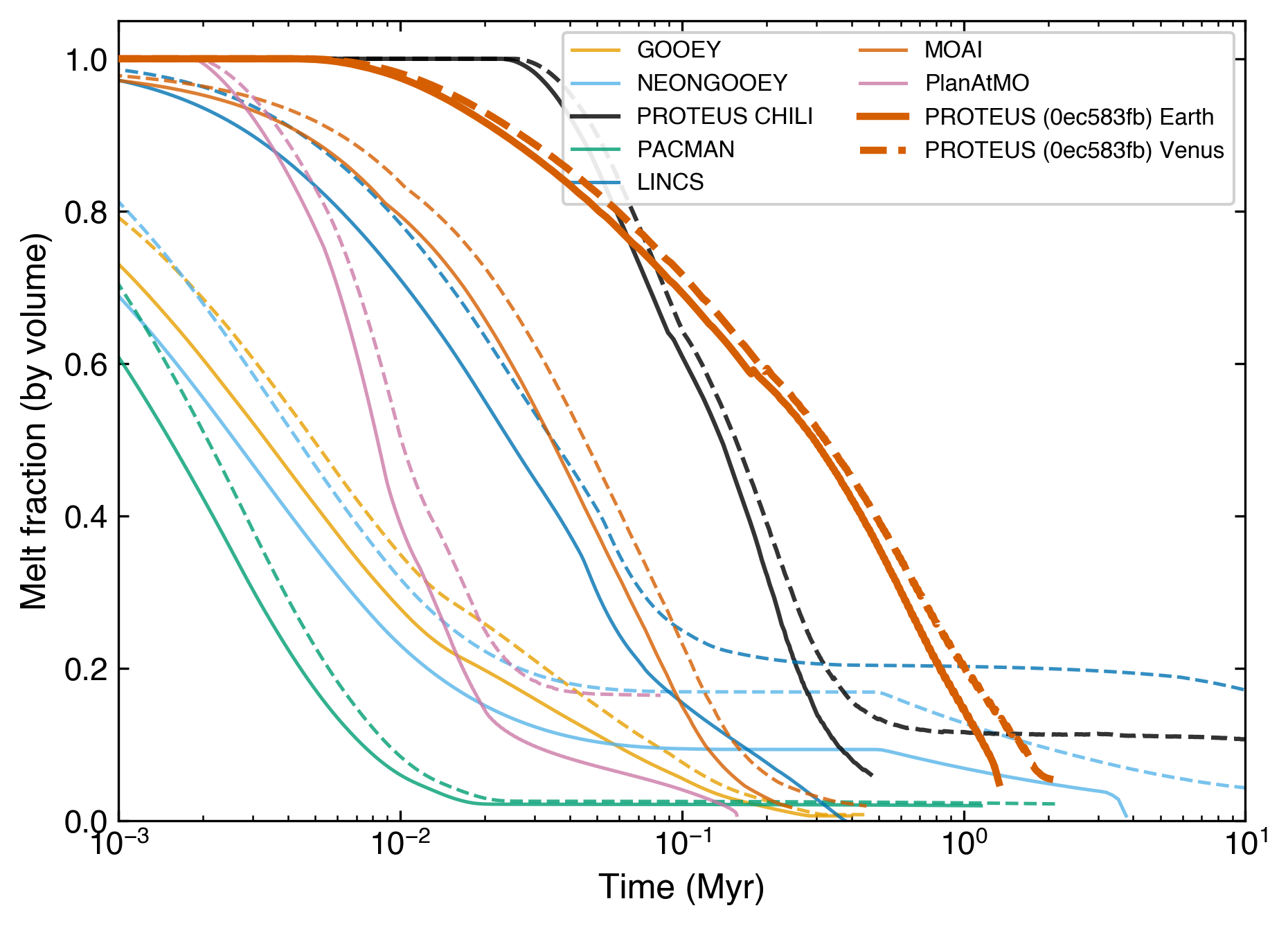
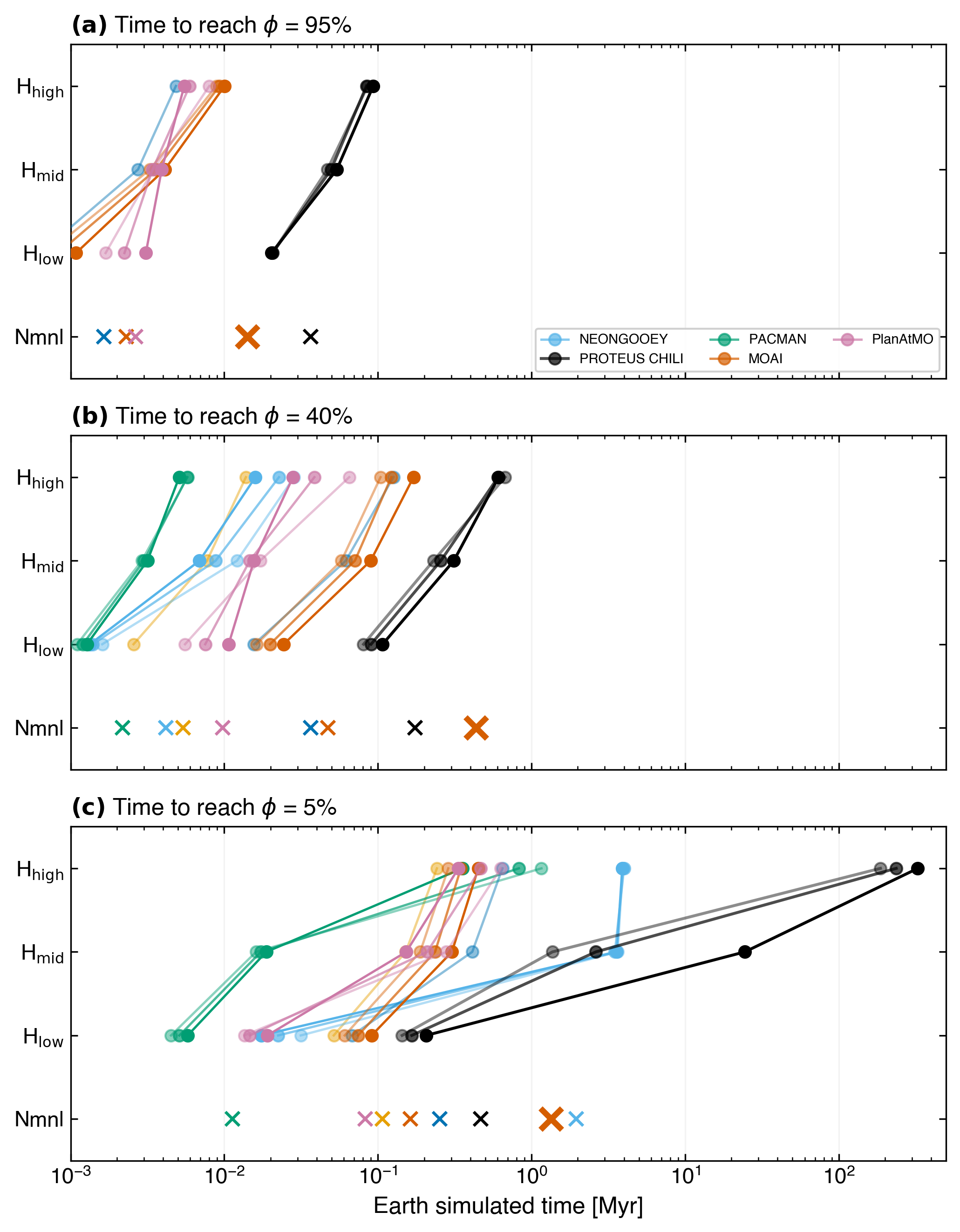
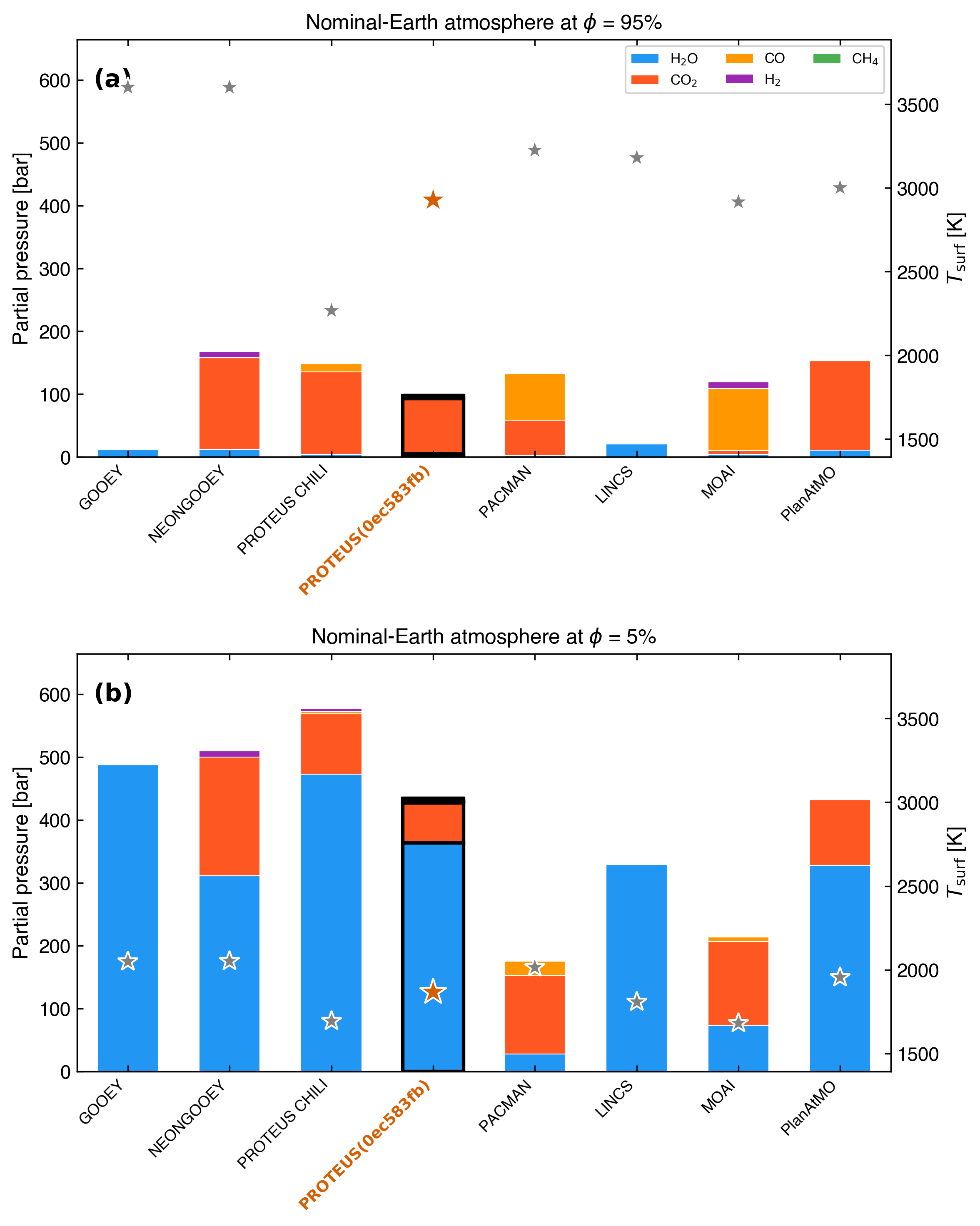
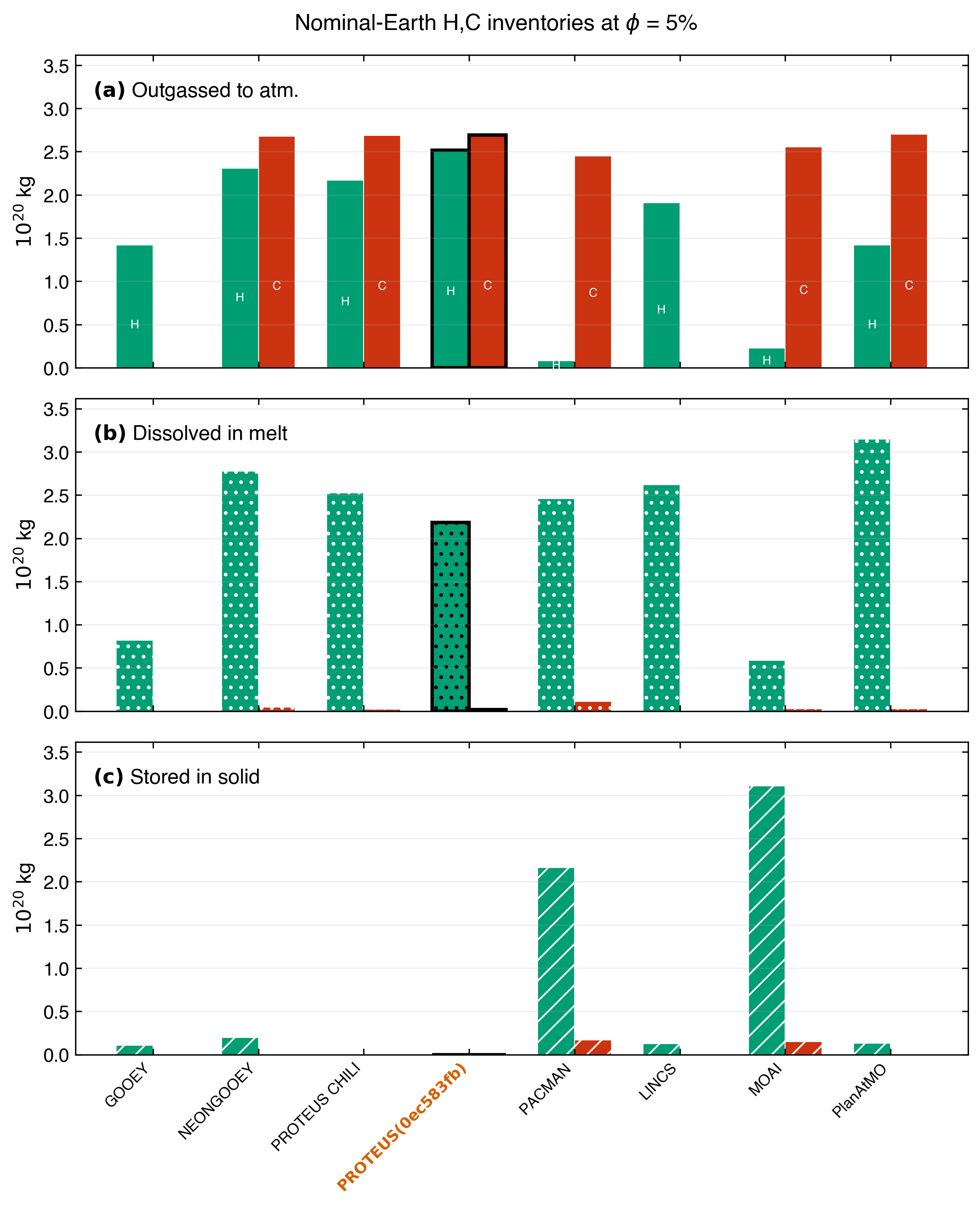
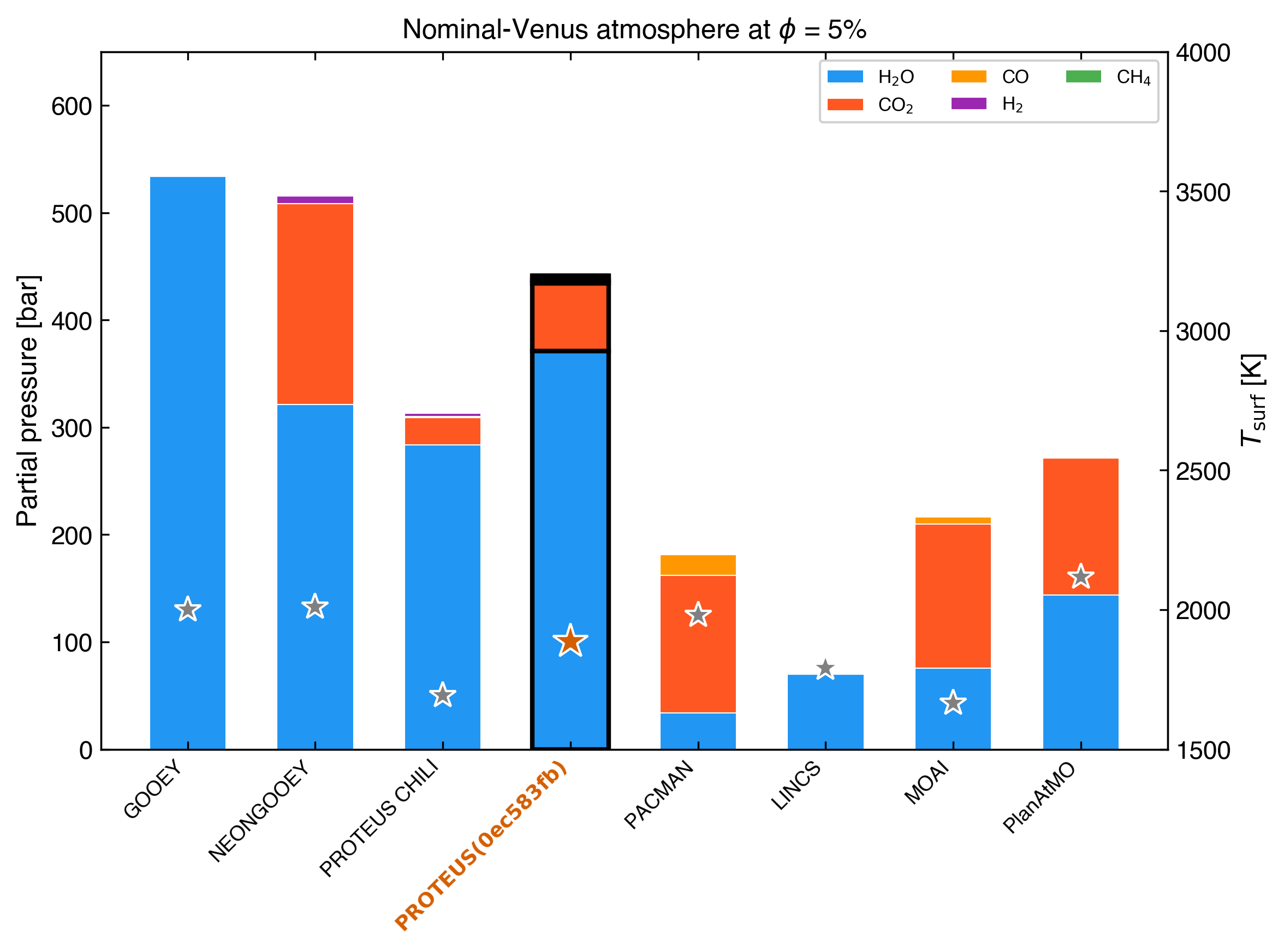
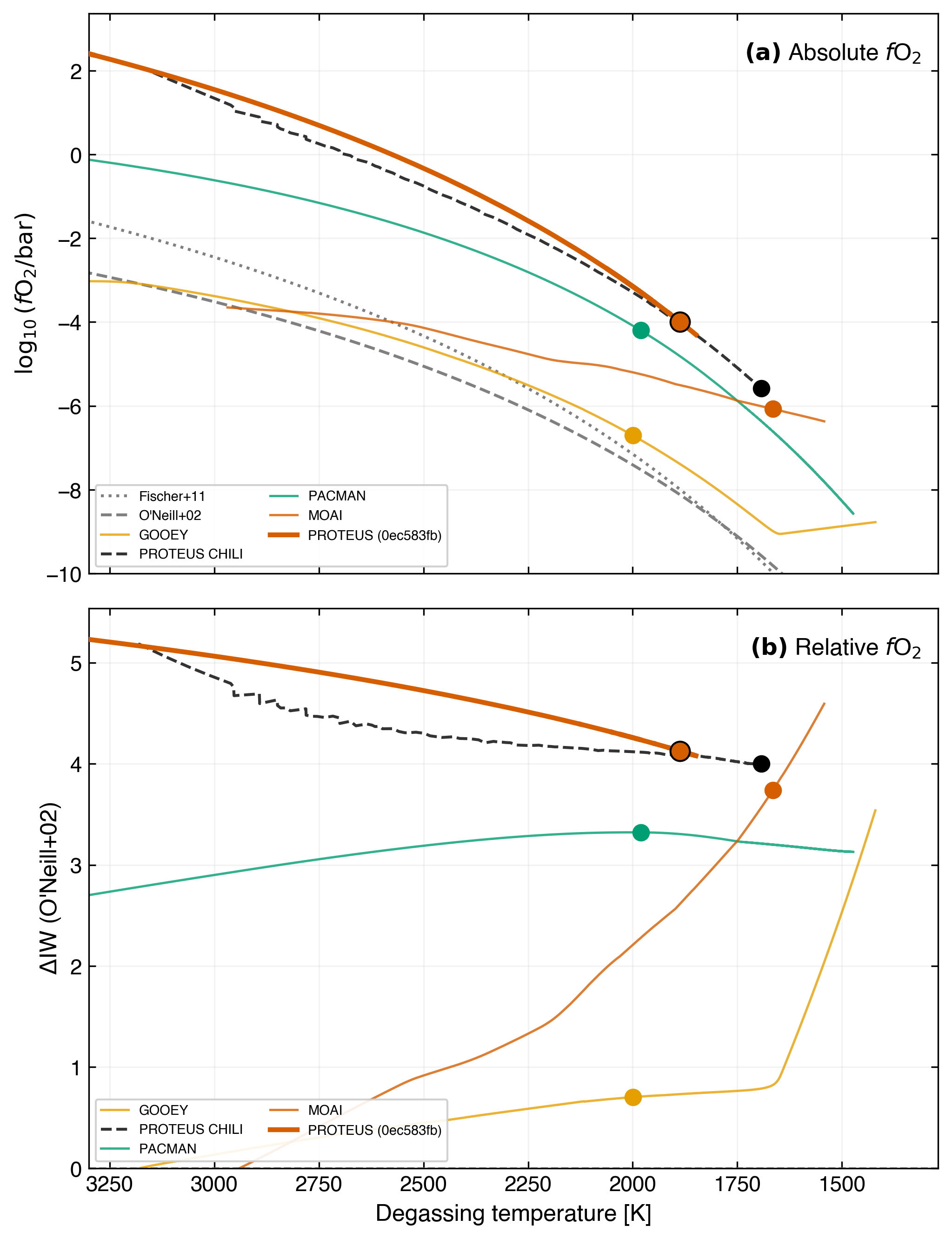
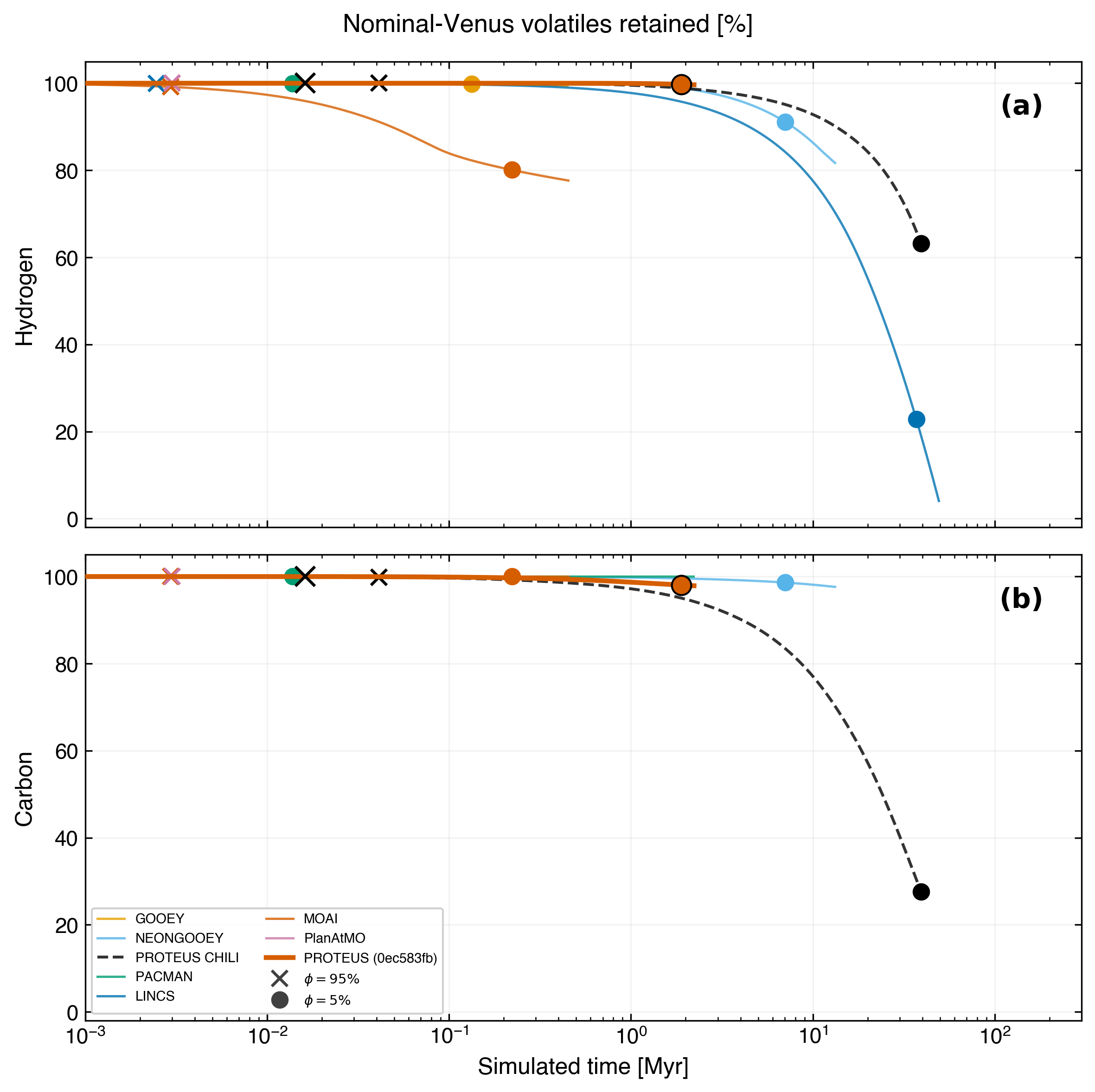
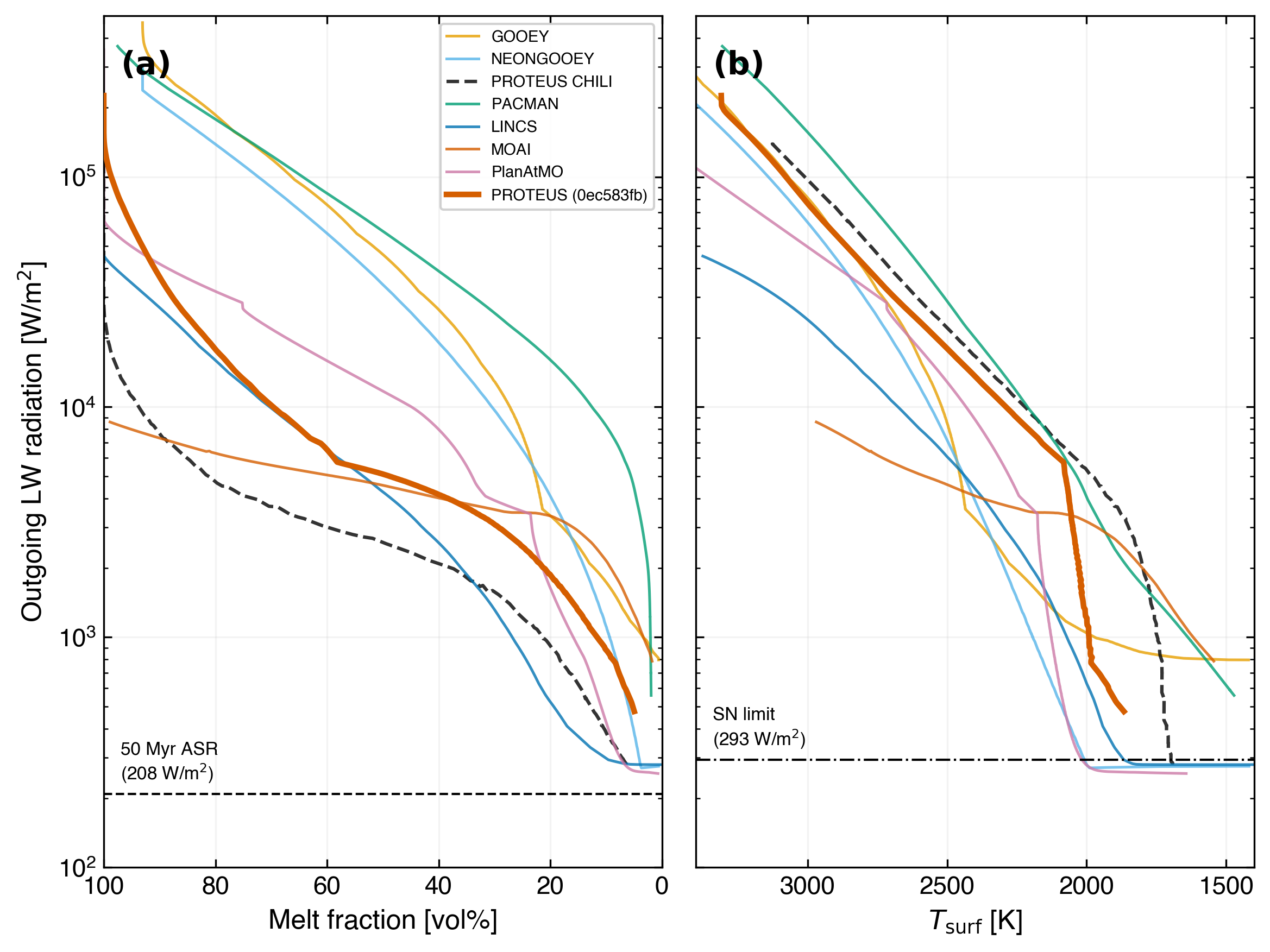
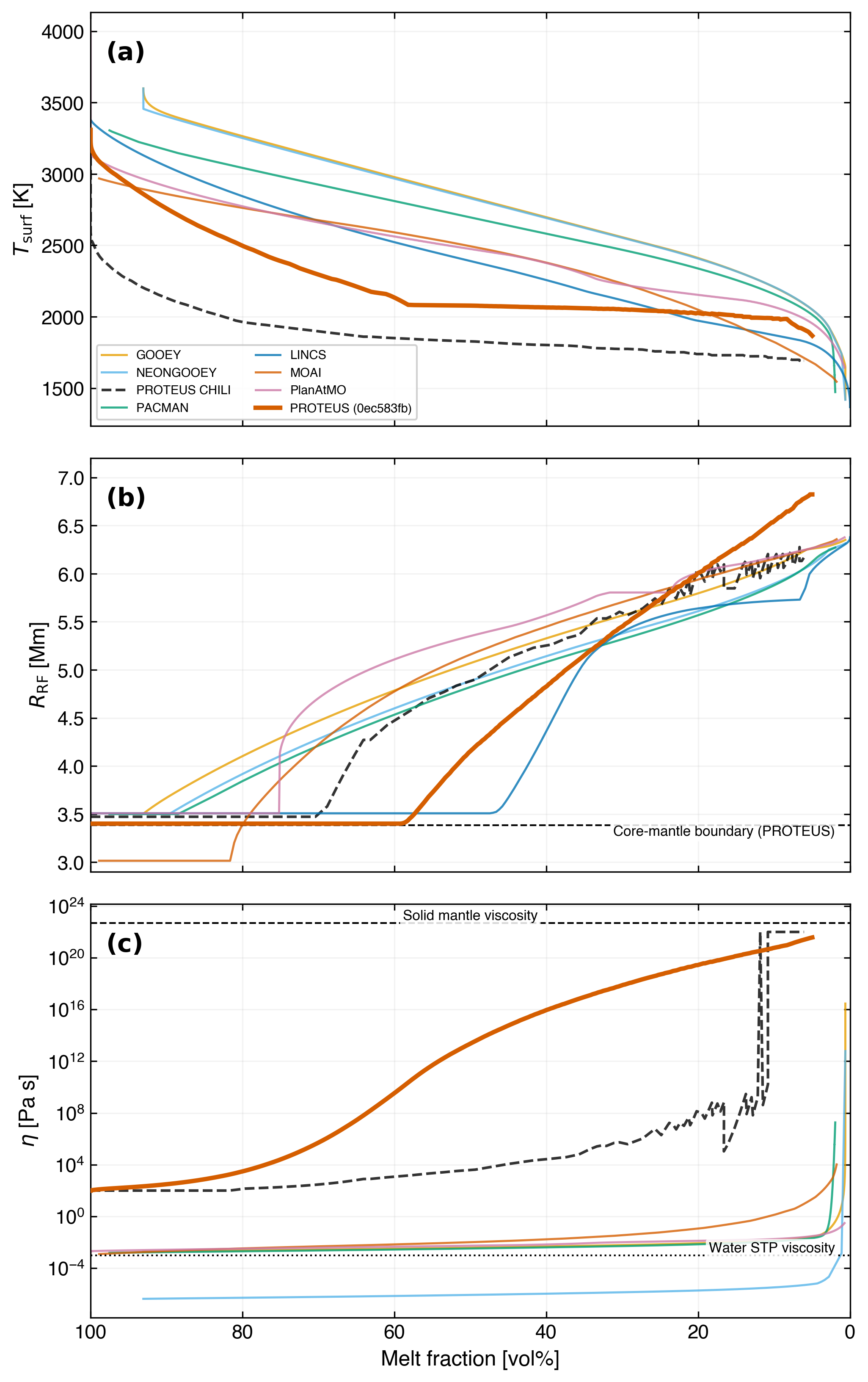
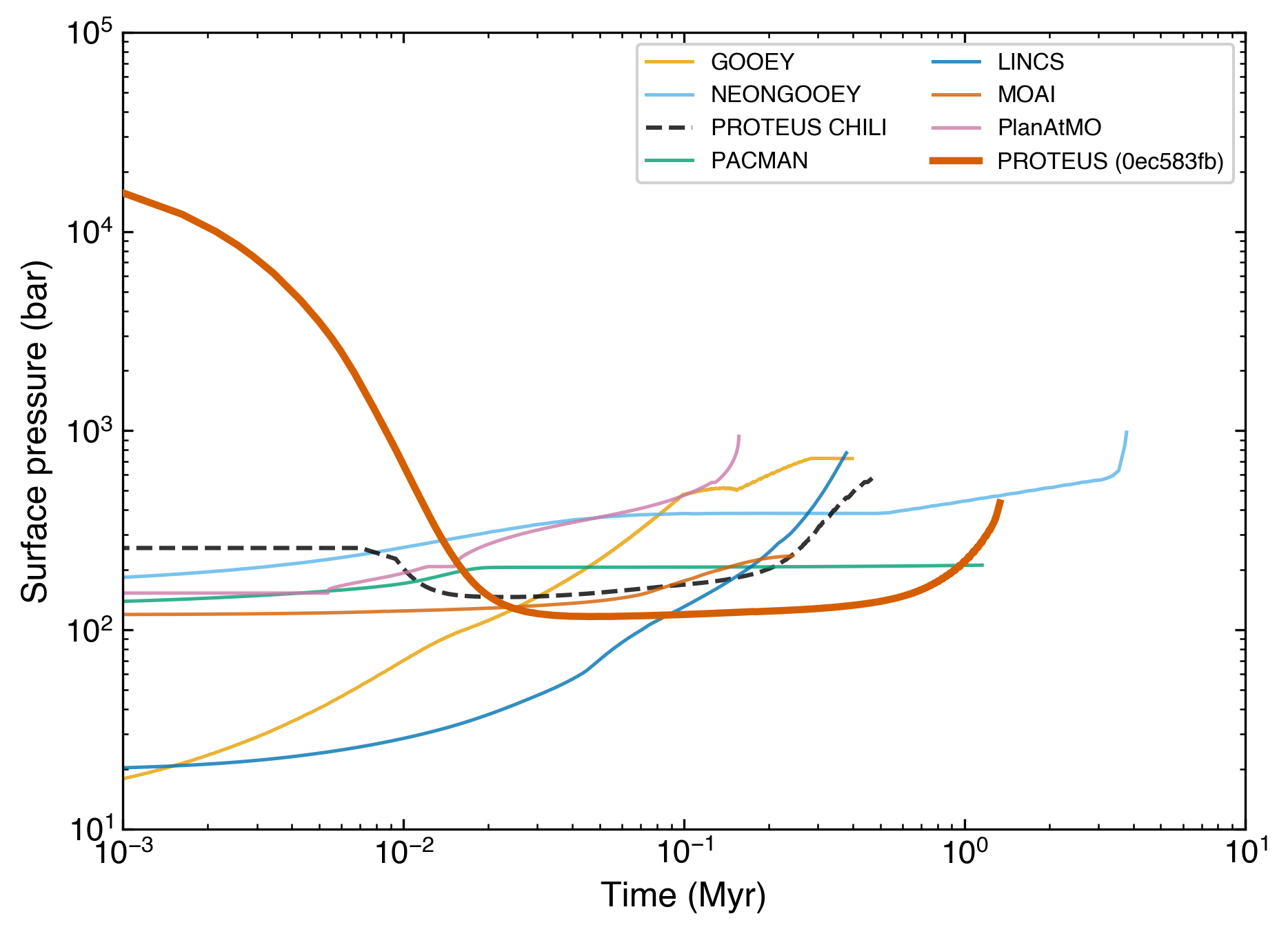
Two PROTEUS curves appear on each plot. The results submitted to the intercomparison (Nicholls et al. 2026, in prep.) are drawn as a thin black dashed line labelled "PROTEUS CHILI". The run from your own checkout is drawn in vermillion with thick lines, black-edged markers, and its git SHA in the legend. Re-running the command on a future PROTEUS version regenerates every figure with that version's SHA, so the comparison stays reproducible without editing the script.
Melt fraction evolution
Solidification milestones
Atmospheric composition
H and C mass budgets
Venus atmospheric composition
Oxygen fugacity
Volatile retention
Outgoing longwave radiation
Geodynamics diagnostics
Surface pressure evolution
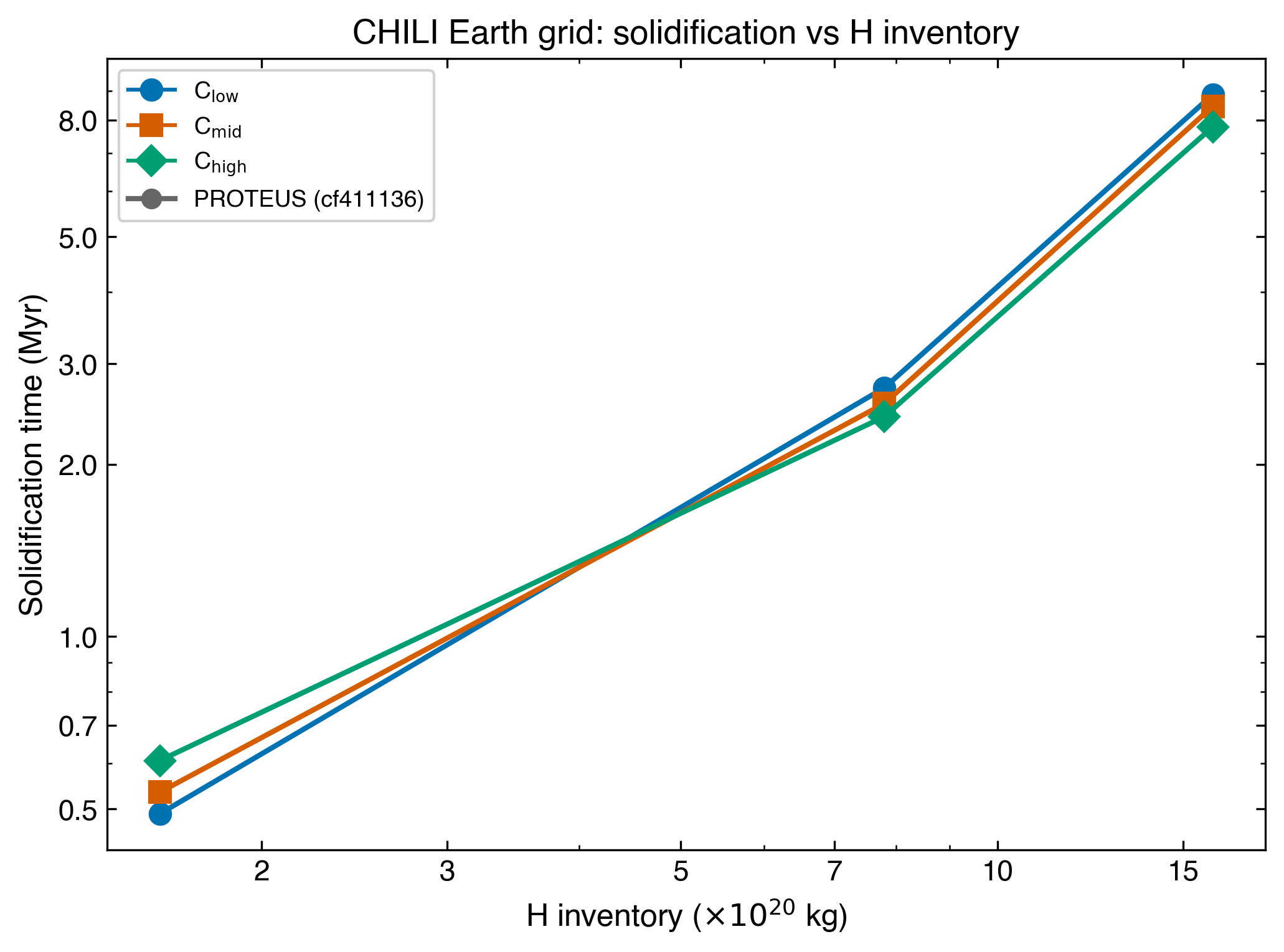
Earth volatile grid
The CHILI Earth grid varies H and C inventories across 9 combinations to explore how volatile budgets control solidification timescale:
| C\(_\mathrm{low}\) (1.36\(\times\)10\(^{20}\) kg) | C\(_\mathrm{mid}\) (2.73\(\times\)10\(^{20}\) kg) | C\(_\mathrm{high}\) (5.44\(\times\)10\(^{20}\) kg) | |
|---|---|---|---|
| H\(_\mathrm{low}\) (1.6\(\times\)10\(^{20}\) kg) | 1 EO, low C | 1 EO, mid C | 1 EO, high C |
| H\(_\mathrm{mid}\) (7.8\(\times\)10\(^{20}\) kg) | 5 EO, low C | 5 EO, mid C | 5 EO, high C |
| H\(_\mathrm{high}\) (16.0\(\times\)10\(^{20}\) kg) | 10 EO, low C | 10 EO, mid C | 10 EO, high C |
Grid configs are in input/tutorials/chili_grid/. Run all 9 cases:
for cfg in input/tutorials/chili_grid/*.toml; do
    name=$(basename "$cfg" .toml)
    outdir="output/chili_grid_earth_${name#earth_}"
    mkdir -p "$outdir"
    nohup proteus start --offline -c "$cfg" \
        > "/tmp/proteus_grid_${name}.log" 2>&1 & disown
done
Check status of running grid cases:
for d in output/chili_grid_earth_*/; do
    printf "%-40s %s\n" "$(basename $d)" "$(cat $d/status 2>/dev/null || echo 'not started')"
done
Runtime
Low-H cases finish in ~1 hour. Mid-H cases take ~3-5 hours. High-H cases (10 Earth oceans) may take 12+ hours because the thick steam atmosphere reduces OLR to a few hundred W m\(^{-2}\) in the late mushy zone.
Grid results
Solidification times for the completed grid cases:
| C\(_\mathrm{low}\) | C\(_\mathrm{mid}\) | C\(_\mathrm{high}\) | |
|---|---|---|---|
| H\(_\mathrm{low}\) (1 EO) | 0.49 Myr | 0.53 Myr | 0.61 Myr |
| H\(_\mathrm{mid}\) (5 EO) | 2.72 Myr | 2.55 Myr | 2.42 Myr |
| H\(_\mathrm{high}\) (10 EO) | 8.85 Myr | 8.45 Myr | 7.78 Myr |
Hydrogen inventory is the primary control on solidification timescale: a ~5x increase in H budget (1 to 5 EO) delays solidification by a factor of ~5, and a further 2x increase (5 to 10 EO) adds another factor of ~3 (2.5 to 8.5 Myr). The carbon effect is secondary and non-monotonic. At low H, more CO\(_2\) adds greenhouse opacity and slows cooling (0.49 to 0.61 Myr). At mid and high H, the effect reverses: more CO\(_2\) raises P\(_\mathrm{surf}\), which via Henry's law enhances H\(_2\)O dissolution in the silicate melt, reducing the atmospheric H\(_2\)O greenhouse and allowing higher OLR (2.72 to 2.42 Myr at mid-H; 8.85 to 7.78 Myr at high-H).
Current PROTEUS configuration vs the CHILI submission
Every figure shows two PROTEUS curves, and the gap between them is itself informative because the two come from different model configurations. The protocol fixes the inputs that both share: a bulk-silicate-Earth composition, oxygen fugacity at IW+4, a Bond albedo of 0.1, and a 50 Myr stellar age 1. What differs is the interior machinery.
The PROTEUS results submitted to the intercomparison were computed with an earlier version of PROTEUS, not the configuration documented here. That version used SPIDER for the interior thermal evolution and an Adams-Williamson integration for the interior structure. See Lichtenberg et al. (2026) 1 and Nicholls et al. (2026, in prep.) 2 for further details.
The configuration documented on this page uses Aragog for the interior thermal evolution and Zalmoxis for the interior structure. Aragog is the Python reimplementation of SPIDER and integrates the same specific-entropy equation for a two-phase, partially molten mantle with a mixing-length convective closure. The main change is on the structure side: Zalmoxis replaces the Adams-Williamson approximation, solving the layered interior (mass, radius, density profile, and core-mantle-boundary radius) directly and supplying the pressure-entropy equation-of-state tables that Aragog reads.
Takeaways
Earth and Venus begin from the same fully molten state and diverge as they cool. Across the model ensemble both solidify on million-year timescales, with Venus lagging Earth because its higher instellation slows radiative cooling, and the spread between codes at any given moment reflects genuine differences in how each treats atmospheric opacity, volatile partitioning, and interior convection. PROTEUS captures this evolution by coupling a radiative-convective atmosphere, equilibrium outgassing, and a 1D interior solver, advancing the magma ocean from melt through solidification while tracking the volatiles exchanged between the mantle and the atmosphere.
The point of this tutorial is to place the current PROTEUS against that published ensemble on demand. The comparison figures are regenerated from your own checkout and labelled with its git commit, so re-running the plotting command benchmarks whatever version of PROTEUS you are running against the fixed literature values from the CHILI papers. It is therefore an always-current intercomparison: a quick way to confirm that a new PROTEUS release still reproduces the established Earth and Venus solidification behaviour, and to see where it sits relative to the other community codes.
See also: Earth analogue | Model description | Output format
-
Lichtenberg, T., Schaefer, L., Krissansen-Totton, J., et al., Coupled atmospHere Interior modeL Intercomparison (CHILI): Protocol Version 1.0, The Planetary Science Journal, 7, 108, 2026. SciX. ↩↩↩
-
Nicholls, H. et al., Coupled atmospHere Interior modeL Intercomparison (CHILI). I. Evolutionary Modelling: Primordial Magma Oceans of Earth and Venus, in preparation, 2026. ↩↩