Validation: src/proteus/outgas/atmodeller.py
What this page checks
This page checks how the atmodeller wrapper, proteus.outgas.atmodeller, splits the mass of each gas species into the masses of its elements. Validation means that a test runs the code on a case with a known right answer and checks the result within a stated tolerance. If this split is wrong, the element budgets of H, C, N, S and O in each reservoir are wrong. The case below says why the check exists, what it tests, how we know the right answer and why it matters. A box "Test details" ends the case. The reference_pinned marker is registered in pyproject.toml.
| Test id | Reference | Source page | Scope |
|---|---|---|---|
tests/outgas/test_atmodeller.py::test_water_split_matches_closed_form_mass_fractions |
IUPAC atomic masses (https://iupac.qmul.ac.uk/AtWt/); the per-element mass fraction of a molecule is an analytic identity | n/a (closed form) | Pins the species-to-element mass split for water: the oxygen mass fraction of H2O is m_O / (2 m_H + m_O) = 0.88809 and the hydrogen fraction is the complement 0.11191. A discrimination guard rules out a naive equal (0.5/0.5) split. Also pins mass conservation (the split sums back to the species mass) and that the helper writes the reservoir split ({e}_kg_atm) but not the escape-owned {e}_kg_total. |
Element mass fractions of water
Why this check exists. Each species mass must go to its elements by mass fraction. An equal split between the elements, or a split that loses mass, gives wrong element budgets without an error message.
What it tests. For a molecule, the mass fraction of element \(e\) is \(f_e = n_e m_e / \sum_i n_i m_i\), with \(n_i\) the number of atoms and \(m_i\) the atomic masses. For water the oxygen fraction is 0.88809 and the hydrogen fraction 0.11191. The test splits a mass of water with _populate_volatile_element_reservoirs and checks:
- the oxygen and hydrogen masses against these fractions;
- that the hydrogen mass is more than 0.3 of the water mass away from an equal 0.5 split;
- that the 2 element masses sum back to the water mass;
- that the helper writes
{e}_kg_atmbut not{e}_kg_total, which the escape step owns.
How we know the right answer. The mass fraction of an element in a molecule is a closed-form identity; with the IUPAC atomic masses it gives 0.88809 for oxygen in water.
Why it matters. The atmodeller wrapper calls _populate_volatile_element_reservoirs after each solve to fill the element reservoirs {e}_kg_atm, _kg_liquid and _kg_solid; the escape step reads {e}_kg_atm.
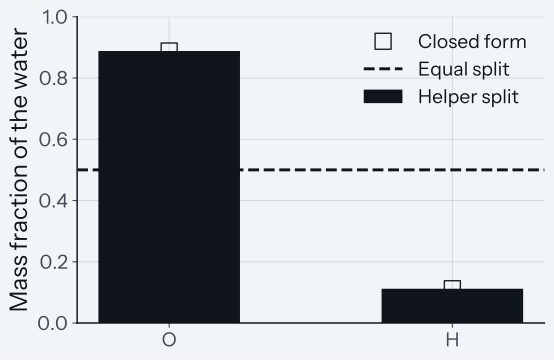
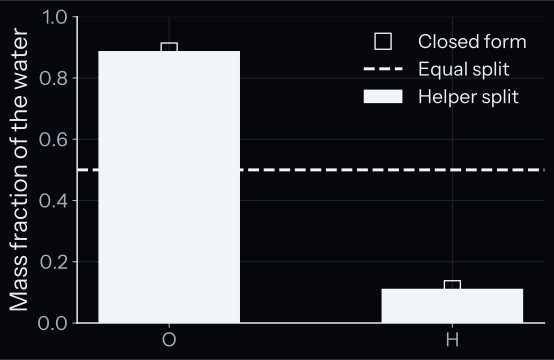
How to read the plot. The bars are the asserted O and H masses that _populate_volatile_element_reservoirs gives, divided by the 4e21 kg of water. The hollow squares are the closed-form mass fractions 0.88809 and 0.11191, asserted to relative 1e-4. The dashed line is the equal split, which the test rejects. A pass means that each square sits on the top of its bar.
Test details
- Reference: IUPAC atomic masses (https://iupac.qmul.ac.uk/AtWt/); the per-element mass fraction of a molecule (closed form).
- Tolerance: relative 1e-4 on the fractions 0.88809 and 0.11191; relative 1e-12 on the sum.
- Test id:
tests/outgas/test_atmodeller.py::test_water_split_matches_closed_form_mass_fractions - Command:
pytest -m reference_pinned tests/outgas/test_atmodeller.py --validation-plots
Re-derivation note
For a molecule with n_e atoms of element e and constituent atomic masses
m_i, the element's mass fraction is
f_e = n_e * m_e / sum_i (n_i * m_i)
For H2O (m_H = 1.008e-3, m_O = 15.999e-3 kg/mol):
f_O = 15.999 / (2 * 1.008 + 15.999) = 15.999 / 18.015 = 0.88809
f_H = 1 - f_O = 0.11191
_populate_volatile_element_reservoirs applies this per species and per
reservoir, so the per-element reservoir masses conserve the total volatile mass
exactly (independent of the absolute accuracy of the atomic-mass table, because
the same table sets both numerator and denominator).
Element-total ownership note
The helper writes only the per-element reservoir split ({e}_kg_atm, _kg_liquid, _kg_solid). It does not write {e}_kg_total: the escape step owns that budget, and for oxygen the separate O_kg_total write owns it, so a species reconstruction cannot overwrite the debited total. The case above asserts this for hydrogen ('H_kg_total' not in hf_row), and tests/outgas/test_from_o_budget_atmodeller.py::test_atmodeller_restores_escape_owned_noble_total checks that a noble-gas total keeps its value through a solve.
Atmospheric mass note
For each gas species, the atmodeller output gives the conserved constraint total_mass, the melt share dissolved_mass and the gas-phase mass gas_mass. The wrapper writes gas_mass to {sp}_kg_atm and dissolved_mass, limited to 0 to total_mass, to {sp}_kg_liquid (tests/outgas/test_atmodeller.py::test_element_split_closes_against_budget_across_redox).
total_mass - dissolved_mass equals gas_mass only while no gas species holds a solid-phase reservoir. When the 2 differ by more than 1 kg and a relative 1e-6, the wrapper keeps gas_mass and logs a warning (tests/outgas/test_from_o_budget_atmodeller.py::test_solver_gas_mass_is_authoritative_over_total_minus_dissolved).
When the output omits gas_mass, the wrapper takes total_mass - dissolved_mass (tests/outgas/test_from_o_budget_atmodeller.py::test_noble_gas_passed_as_mass_constraint_and_uses_total_mass_output). Without total_mass too, it takes the column mass \(p A / g\) from the partial pressure \(p\), the surface area \(A\) and the gravity \(g\), and logs a warning (tests/outgas/test_atmodeller.py::test_atm_mass_falls_back_to_thin_atm_recon_when_gas_mass_absent). This column mass misweights a species whose molar mass differs from the mean molar mass.