Validation: src/proteus/outgas/burial_ledger.py
What this page checks
This page checks the burial ledger, proteus.outgas.burial_ledger. When the magma ocean freezes, trapping buries volatiles in the solid; the ledger records at which melt fraction \(\Phi\) each amount was buried, so that a remelt returns the most recently buried mass first. Validation means that a test runs the code on a case with a known right answer and checks the result within a stated tolerance. If the ledger is wrong, a remelt returns the wrong amount of each volatile to the melt. The case below says why the check exists, what it tests, how we know the right answer and why it matters. A box "Test details" ends the case.
| Test id | Reference | Scope | Last compared |
|---|---|---|---|
tests/outgas/test_burial_ledger.py::test_the_ledger_matches_a_fine_grid_over_a_random_history |
Cross-implementation check against an independent ledger on a grid of 2e5 melt-fraction bins, which deposits each freeze uniformly over its bins and empties every bin below the melt fraction after each remelt | A seeded history of 400 steps that mostly freeze and sometimes remelt. The mass held below four melt fractions agrees to rel=1e-3, the discretisation error of one grid bin, and the total held to 1e-9. |
2026-10-01 |
The ledger against a fine grid
Why this check exists. The ledger stores buried mass in layers that freezing adds and remelting removes. A wrong layer split or a wrong order of removal returns the wrong mass on a remelt without an error message.
What it tests. A seeded history of 400 steps that mostly freeze and sometimes remelt. After the history, the mass that the ledger holds below 4 melt fractions must agree with a second, independent ledger. The total mass held must also agree, and it must be less than 90 % of the mass buried, because the history remelts.
How we know the right answer. The second ledger uses a grid of 2e5 melt-fraction bins. It deposits each freeze uniformly over its bins and empties every bin below the melt fraction after each remelt. It uses no function of burial_ledger, and its discretisation error is about one grid bin.
Why it matters. proteus.outgas.trapping uses the ledger (build_ledger, ledger_total, remelt_to) for the volatiles held in the solid; it sets the trapped mass of each species that a re-melt returns to the melt.
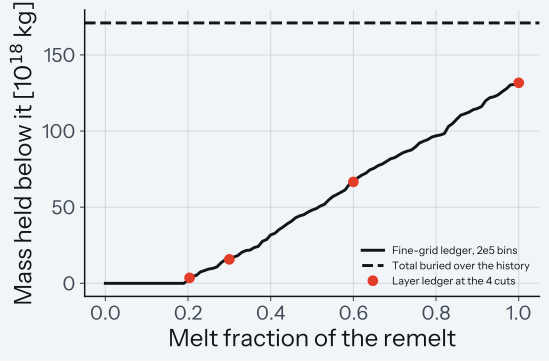
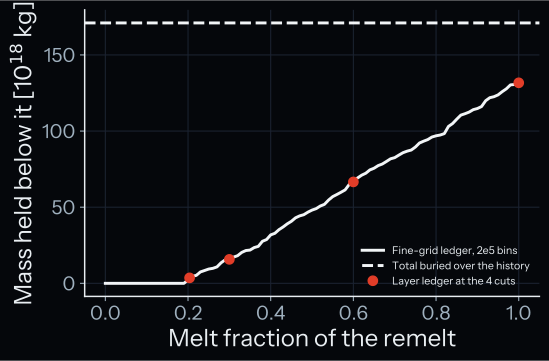
How to read the plot. The x-axis is the melt fraction of a later remelt, and the y-axis the mass that the ledger holds below it. The history is a seeded random sequence of 400 steps. The line is an independent fine-grid ledger with 2e5 bins. The filled circles are the asserted values of the layer ledger at 4 remelt melt fractions. The dashed line is the total mass buried over the history; the ledger holds less, because the history remelts. A pass means that the circles lie on the line (relative 1e-3).
Test details
- Reference: cross-implementation check against an independent ledger on a grid of 2e5 melt-fraction bins.
- Tolerance: relative 1e-3 on the mass held below each of 4 melt fractions (the discretisation error of one grid bin); relative 1e-9 on the total held.
- Test id:
tests/outgas/test_burial_ledger.py::test_the_ledger_matches_a_fine_grid_over_a_random_history - Command:
pytest -m reference_pinned tests/outgas/test_burial_ledger.py --validation-plots
Invariants checked alongside
- A remelt returns the most recently buried mass first: after freezing from
Phi = 1to 0.7 and on to 0.5, remelting to 0.6 returns half of the second layer, not a fifth of everything. - Returned plus still held equals buried, after every remelt.
- Freezing and remelting the same interval cancel. In
tests/outgas/test_trapping.pya closed melt cycled a hundred times betweenPhi = 0.41and 0.40 keeps its trapped water to1e-12, where releasing the mean of the solid raises it by 4.4% a cycle.