Speciation phase diagram
The first-run tutorial swept one parameter (\(\Delta\mathrm{IW}\)) at fixed temperature. Real magma oceans cool and re-equilibrate, so the dominant atmospheric species can shift as both \(T\) and \(\Delta\mathrm{IW}\) evolve. This tutorial generalises the 1D sweep to a 2D grid and builds a speciation phase diagram: at every \((T, \Delta\mathrm{IW})\) point, what are the four most abundant volatile species, and how does that quartet shift across the plane?
By the end of it you will:
- have run CALLIOPE on a 2D parameter grid using a warm-started serpentine sweep so the wall-time stays manageable;
- have produced the top-4 species map on the front of this page (each cell subdivided into four quadrants showing the species at ranks 1 through 4);
- understand why Earth-BSE atmospheres are CO- or CO\(_2\)-dominated rather than H\(_2\)O-dominated in the magma-ocean regime, and how the second through fourth species shift in lockstep with the dominant one.
You should already have completed the First run tutorial so the equilibrium_atmosphere call signature is familiar.
Step 1: set up the sweep
import warnings

import numpy as np

from calliope.constants import volatile_species
from calliope.solve import equilibrium_atmosphere

planet = {'M_mantle': 4.03e24, 'gravity': 9.81, 'radius': 6.371e6}

# Earth-BSE H/C/N/S in kg (Krijt et al. 2023, PPVII Tables 1 and 2).
earth_hcns = {'H': 5.6e20, 'C': 3.1e21, 'N': 3.7e19, 'S': 1.0e21}

T_grid   = np.linspace(1500.0, 3000.0, 15)
diw_grid = np.linspace(  -4.0,    5.0, 12)

species_to_report = ['H2O', 'CO2', 'O2', 'H2', 'CO', 'CH4',
                     'N2',  'NH3', 'S2', 'SO2', 'H2S']

pressures = np.full((T_grid.size, diw_grid.size, len(species_to_report)), np.nan)
rank_idx  = np.full((T_grid.size, diw_grid.size, 4), -1, dtype=int)
P_total   = np.full((T_grid.size, diw_grid.size), np.nan)


def base_ddict(T, diw):
    d = {**planet, 'T_magma': T, 'Phi_global': 1.0, 'fO2_shift_IW': diw}
    for sp in volatile_species:
        d[f'{sp}_included']    = 1
        d[f'{sp}_initial_bar'] = 0.0
    return d
In the loop below we keep the full partial-pressure vector at each grid point, not just the index of the dominant species, so the figure step can sort and pick the top four.
Step 2: warm-start along \(\Delta\mathrm{IW}\) at each \(T\)
Each call from cold takes about a second because the Monte-Carlo restart has to find a basin; with a p_guess from the previous call, subsequent solves complete in milliseconds. The cleanest schedule is a serpentine sweep: walk \(\Delta\mathrm{IW}\) at fixed \(T\), reset between rows.
for iT, T in enumerate(T_grid):
    p_guess = None                              # cold-start each row
    for jd, diw in enumerate(diw_grid):
        ddict = base_ddict(float(T), float(diw))
        with warnings.catch_warnings():
            warnings.simplefilter('ignore')
            try:
                res = equilibrium_atmosphere(
                    earth_hcns, ddict, p_guess=p_guess, print_result=False,
                )
            except Exception:
                p_guess = None                  # invalidate guess on failure
                continue
        ps = np.array([res[f'{sp}_bar'] for sp in species_to_report])
        pressures[iT, jd] = ps
        order = np.argsort(ps)[::-1]
        rank_idx[iT, jd]  = order[:4]            # top-4 species indices
        P_total[iT, jd]   = float(res['P_surf'])
        # carry the four primary partial pressures forward as the next guess
        p_guess = {s: float(res[f'{s}_bar']) for s in ('H2O', 'CO2', 'N2', 'S2')}
A 15 × 12 grid runs in about 30 to 60 seconds on a modern laptop. The grid resolution is a tradeoff: fewer points runs faster but smears the redox boundary; more points sharpens the boundary but adds linearly to the wall time.
If a cell fails to converge
The solver can land in a secondary basin at extreme conditions. The except clause above invalidates the warm start so the next call cold-starts from a fresh Monte-Carlo draw. Failed cells show up as masked (white) in the figure rather than corrupting the colour map.
Step 3: subdivide each cell into a top-4 quartet
Each grid cell is split into a 2 by 2 of sub-cells in reading order: top-left = rank 1 (dominant), top-right = rank 2, bottom-left = rank 3, bottom-right = rank 4. The pcolormesh below works on a doubled grid; the helper inserts a midpoint between every pair of cell edges so each original cell becomes four sub-cells.
import matplotlib.pyplot as plt
from matplotlib.colors import ListedColormap
from matplotlib.patches import Patch

from calliope.constants import dict_colors

# Expand rank_idx into a 2 x 2 sub-grid per original cell. The (sub_T,
# sub_d) coordinates map to ranks 1..4 as documented above.
n_T, n_d = rank_idx.shape[:2]
expanded = np.full((2 * n_T, 2 * n_d), -1, dtype=int)
for iT in range(n_T):
    for jd in range(n_d):
        r1, r2, r3, r4 = rank_idx[iT, jd]
        expanded[2*iT + 1, 2*jd + 0] = r1     # top-left
        expanded[2*iT + 1, 2*jd + 1] = r2     # top-right
        expanded[2*iT + 0, 2*jd + 0] = r3     # bottom-left
        expanded[2*iT + 0, 2*jd + 1] = r4     # bottom-right

# Build a compact palette: only species that actually appear in any
# of the rank-1..rank-4 slots somewhere in the grid.
seen = sorted({int(v) for v in expanded.ravel() if v >= 0})
palette = [dict_colors[species_to_report[i]] for i in seen]
remap = {old: new for new, old in enumerate(seen)}
remapped = np.vectorize(lambda v: remap.get(int(v), -1))(expanded)

def edges_doubled(arr):
    s = arr[1] - arr[0]
    outer = np.concatenate([[arr[0] - 0.5*s],
                            0.5*(arr[:-1] + arr[1:]),
                            [arr[-1] + 0.5*s]])
    mids = 0.5 * (outer[:-1] + outer[1:])
    out = np.empty(2 * outer.size - 1)
    out[0::2] = outer; out[1::2] = mids
    return out

fig, ax = plt.subplots(figsize=(10.5, 5.8))
ax.pcolormesh(edges_doubled(diw_grid), edges_doubled(T_grid),
              np.ma.masked_less(remapped, 0),
              cmap=ListedColormap(palette),
              shading='flat', edgecolors='white', linewidth=0.35)
ax.set_xlabel(r'$\Delta$IW [dex]')
ax.set_ylabel(r'$T_\mathrm{magma}$ [K]')
ax.set_title('Top-4 species per cell at Earth-BSE')

handles = [Patch(facecolor=palette[k], edgecolor='k', linewidth=0.4,
                 label=species_to_report[seen[k]]) for k in range(len(seen))]
ax.legend(handles=handles, loc='upper left', bbox_to_anchor=(1.02, 1.0),
          title='species (any rank)', frameon=False)
fig.savefig('phase_diagram.pdf')
The goal of this tutorial
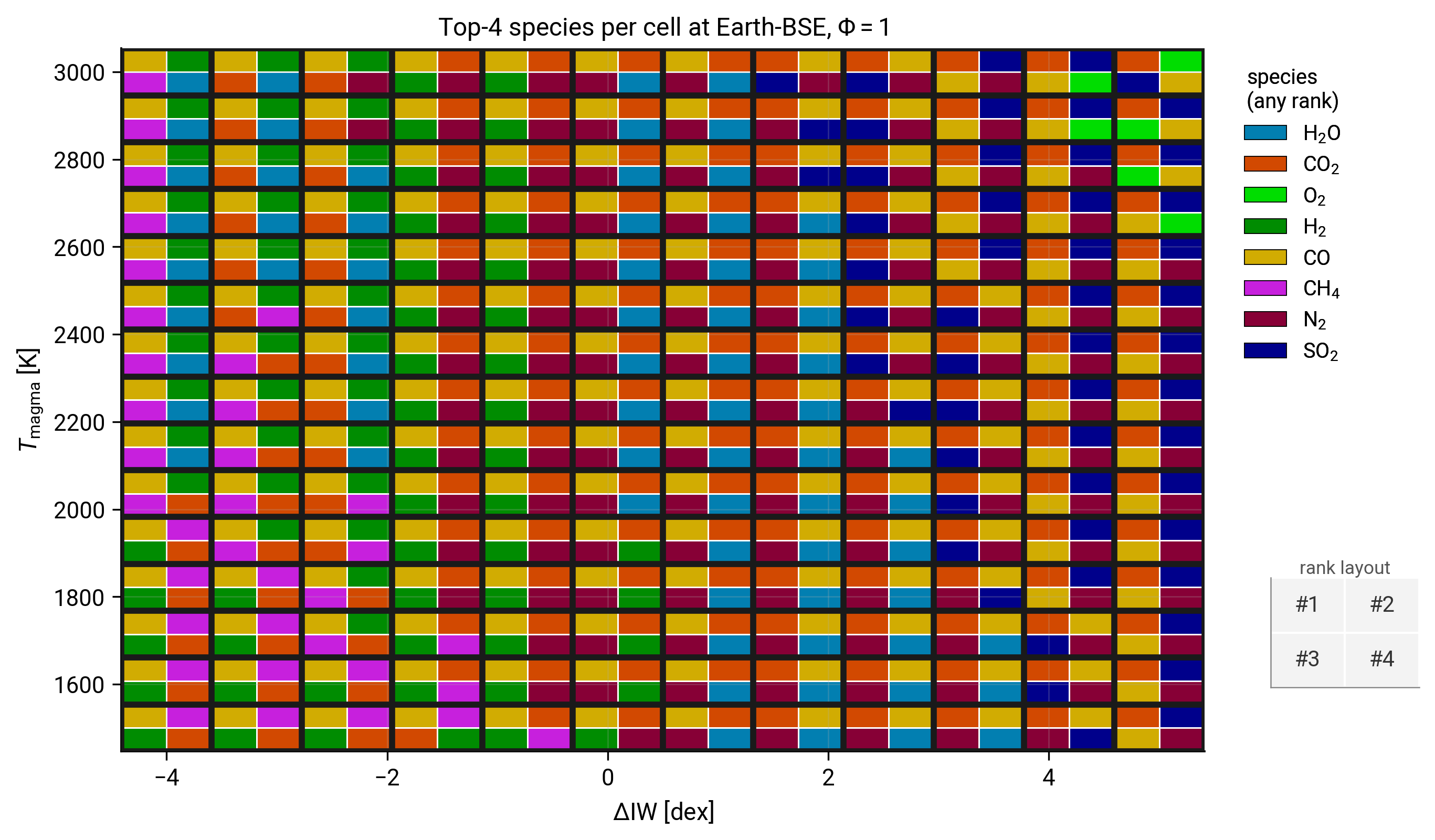
Top-4 volatile species per cell in \((T_\mathrm{magma}, \Delta\mathrm{IW})\) at the Earth-BSE Krijt et al. 2023 2 H/C/N/S budget and \(\Phi = 1\). Each grid cell is subdivided 2 by 2 in reading order (top-left = rank 1, top-right = rank 2, bottom-left = rank 3, bottom-right = rank 4) so the four most abundant species at that simulation point are visible at a glance. The redox boundary in the dominant species (top-left quadrant) separates a CO-dominated reducing regime (left) from a CO\(_2\)-dominated oxidising regime (right); the rank 2 to rank 4 quadrants reveal how H\(_2\), H\(_2\)O, N\(_2\), and SO\(_2\) swap positions across the same boundary. A small CH\(_4\) patch appears near \(T \sim 1900\) K at the most reducing edge of the grid where methane synthesis becomes briefly thermodynamically competitive. At the hot, oxidising corner (\(T \gtrsim 2700\) K and \(\Delta\mathrm{IW} \gtrsim +4\)) molecular O\(_2\) itself enters the top four, reaching rank 2 at \(T = 3000\) K, \(\Delta\mathrm{IW} = +5\) (about 15% of \(P_\mathrm{surf}\)).
The result that may surprise a reader who thinks of magma-ocean atmospheres as "steam-dominated" is that on the Earth BSE inventory carbon sets the dominant species, even though hydrogen outnumbers carbon by molar count (5.6 \(\times 10^{23}\) mol H against 2.6 \(\times 10^{23}\) mol C). The cause is not the bulk inventory ratio but melt solubility: H\(_2\)O is roughly two orders of magnitude more soluble in silicate melt than CO\(_2\), so at \(\Phi = 1\) most of the H budget stays dissolved while most of the C outgases (Bower et al. 2022 1 Section 3). A water-dominated atmosphere needs either a much higher H budget (gas-giant-like) or a much lower C budget (volatile-poor / dehydrated body); the planetary case study tutorial illustrates one such contrast.
The CO / CO\(_2\) phase boundary shifts from \(\Delta\mathrm{IW} \approx +1\) at \(T = 1500\) K to \(\Delta\mathrm{IW} \approx +3\) at \(T = 3000\) K, roughly \(1.5\) dex of \(T\)-dependence across the grid. The shift reflects the temperature dependence of the CO + 1/2 O\(_2\) \(\rightleftharpoons\) CO\(_2\) equilibrium constant (entropy favours CO at high \(T\)). At any given \(T\), the boundary is sharp: cross it and CO\(_2\) takes over within a single grid cell.
A second feature lives at the hot, oxidising corner: molecular O\(_2\) stops being a trace gas. The IW-buffer fugacity climbs steeply with temperature, the Fischer buffer rising about nine orders of magnitude from \(\log_{10} f_{\mathrm{O}_2} \approx -11.6\) at \(1500\) K to \(\approx -2.5\) at \(3000\) K, so a fixed \(\Delta\mathrm{IW}\) offset maps to a far higher absolute O\(_2\) fugacity at high \(T\). At \(T = 3000\) K and \(\Delta\mathrm{IW} = +5\) the O\(_2\) partial pressure reaches a few hundred bar, about \(15\%\) of \(P_\mathrm{surf}\) and second only to CO\(_2\). Below \(\sim 2700\) K, or at reducing \(\Delta\mathrm{IW}\), O\(_2\) falls back below the four reported species and does not appear; this is why the cooler and more reducing parts of the grid show no green.
Where to go next
- For a finer look at the speciation transitions across \(\Delta\mathrm{IW}\) at one \(T\), return to First run Step 6 and use a denser \(\Delta\mathrm{IW}\) grid with this tutorial's warm-start pattern.
- For how PROTEUS handles repeated CALLIOPE calls across a time-stepped simulation, read the next tutorial: Coupled-loop driver.
- For the chemistry behind the dominant-species shifts, read Equilibrium chemistry.
Reproducing the figure
Generated by scripts/tutorials/fig_phase_diagram.py. Re-run with python -m scripts.tutorials.fig_phase_diagram from the repository root.
-
D. J. Bower, K. Hakim, P. A. Sossi, P. Sanan, Retention of water in terrestrial magma oceans and carbon-rich early atmospheres, The Planetary Science Journal, 3(4), 93, 2022. ↩
-
S. Krijt, M. Kama, M. McClure, J. Teske, E. A. Bergin, O. Shorttle, K. J. Walsh, S. N. Raymond, Chemical habitability: supply and retention of life's essential elements during planet formation, in Protostars and Planets VII, S. Inutsuka, Y. Aikawa, T. Muto, K. Tomida, M. Tamura, eds., Astronomical Society of the Pacific Conference Series, 534, 1031, 2023. ↩