Reproducing the Earth fiducial
The Backend comparison explanation page anchors all of its figures on one shared Earth scenario: Krijt et al. 2023 2 BSE H/C/N/S, \(T_\mathrm{magma} = 2000\) K, \(\Phi = 1\), and a volatile O reference of \(1.26 \times 10^{22}\) kg derived to put CALLIOPE on the Sossi et al. 2020 3 \(\Delta\mathrm{IW} = +3.5\) Earth upper-mantle anchor with the current default Fischer 2011 buffer. This tutorial walks you through reproducing those numbers from scratch so you can verify the docs are still consistent with the current solver, and so you have the workflow on hand when you want to anchor your own runs to a literature value.
By the end of it you will:
- have reproduced the \(O = 1.26 \times 10^{22}\) kg volatile-O reference from the Krijt H/C/N/S budget;
- have verified that the authoritative-O entry point recovers \(\Delta\mathrm{IW} = +3.5\) from that O reference to within solver tolerance;
- understand why the buffered call at high \(\Delta\mathrm{IW}\) + carbon-rich BSE needs a tight
p_guess(it has a spurious secondary basin without it).
You should already have completed Two-mode round-trip, which introduces both entry points.
Step 1: pin the Krijt+2023 H/C/N/S budget
import warnings

from calliope.constants import volatile_species
from calliope.solve import (
    equilibrium_atmosphere,
    equilibrium_atmosphere_authoritative_O,
)

planet  = {'M_mantle': 4.03e24, 'gravity': 9.81, 'radius': 6.371e6}
T_magma = 2000.0
diw_anchor = 3.5   # Sossi et al. 2020 Earth upper-mantle estimate

# Krijt et al. 2023 PPVII Tables 1 and 2 BSE row (kg).
earth_hcns = {'H': 5.6e20, 'C': 3.1e21, 'N': 3.7e19, 'S': 1.0e21}
Step 2: derive the volatile-O reference via buffered mode
This is the step that needs the tight p_guess.
Without one, the buffered solver at high \(\Delta\mathrm{IW}\) with a carbon-rich BSE inventory has two basins: the physical CO\(_2\)-dominated one at \(P_\mathrm{surf} \approx 1755\) bar with \(p_\mathrm{H_2O} \approx 5.6\) bar, and a spurious H\(_2\)O-free one at lower \(P_\mathrm{surf}\) with \(p_\mathrm{H_2O} = 0\). The Monte-Carlo restart lands in the spurious basin a few percent of the time, which is rare but too often for a reproducible tutorial.
A p_guess near the CO\(_2\)-dominated basin pins the right answer reliably:
ddict = {**planet, 'T_magma': T_magma, 'Phi_global': 1.0,
         'fO2_shift_IW': diw_anchor}
for sp in volatile_species:
    ddict[f'{sp}_included']    = 1
    ddict[f'{sp}_initial_bar'] = 0.0

# Pin the canonical CO2-dominated basin. Numbers are approximate; the
# solver tightens them to the converged values during fsolve.
canonical_guess = {'H2O': 5.0, 'CO2': 1500.0, 'N2': 3.0, 'S2': 1e-3}

with warnings.catch_warnings():
    warnings.simplefilter('ignore')
    buf = equilibrium_atmosphere(
        earth_hcns, ddict, p_guess=canonical_guess, print_result=False,
    )

print(f'derived O_kg_total = {buf["O_kg_total"]:.3e} kg')
print(f'P_surf            = {buf["P_surf"]:.0f} bar')
print(f'H2O               = {buf["H2O_bar"]:.2f} bar')
print(f'CO2               = {buf["CO2_bar"]:.0f} bar')
Expected output:
derived O_kg_total = 1.260e+22 kg
P_surf            = 1755 bar
H2O               = 5.59 bar
CO2               = 1557 bar
This is the canonical Earth volatile-O reference under the current Fischer 2011 buffer default and matches the value used on the backend-comparison page.
Why a CO\(_2\)-dominated atmosphere here, not steam?
The cause is melt solubility, not bulk inventory. Earth's BSE inventory contains \(\sim 5.6 \times 10^{23}\) mol H and \(\sim 2.6 \times 10^{23}\) mol C, so hydrogen atoms outnumber carbon atoms by a factor of two. But at \(\Phi = 1\) most of the H stays dissolved in the silicate melt because H\(_2\)O is roughly two orders of magnitude more soluble in basalt than CO\(_2\) is; most of the C outgases. The atmosphere therefore looks CO\(_2\)-dominated even though the bulk volatile budget is H-rich. See Speciation phase diagram for the same regime mapped across \((T, \Delta\mathrm{IW})\).
Step 3: round-trip through authoritative-O
Feed the derived O budget into the authoritative-O entry point and verify that it recovers the input \(\Delta\mathrm{IW}\) within solver tolerance:
target = dict(earth_hcns); target['O'] = buf['O_kg_total']
p_guess = {s: float(buf[f'{s}_bar']) for s in ('H2O', 'CO2', 'N2', 'S2')}

with warnings.catch_warnings():
    warnings.simplefilter('ignore')
    auth = equilibrium_atmosphere_authoritative_O(
        target, ddict, p_guess=p_guess, fO2_hint=diw_anchor,
        print_result=False,
    )

residual = auth['fO2_shift_derived'] - diw_anchor
print(f'recovered Delta-IW = {auth["fO2_shift_derived"]:+.4f}')
print(f'residual           = {residual:+.2e} dex')
Expected output: residual \(\lesssim 10^{-9}\) dex, i.e. essentially zero (the exact value depends on solver tolerance and starting point). The full provenance chain (Krijt H/C/N/S \(\to\) buffered mode \(\to\) derived O \(\to\) authoritative-O \(\to\) \(\Delta\mathrm{IW}\)) closes at the Sossi 2020 anchor.
The goal of this tutorial
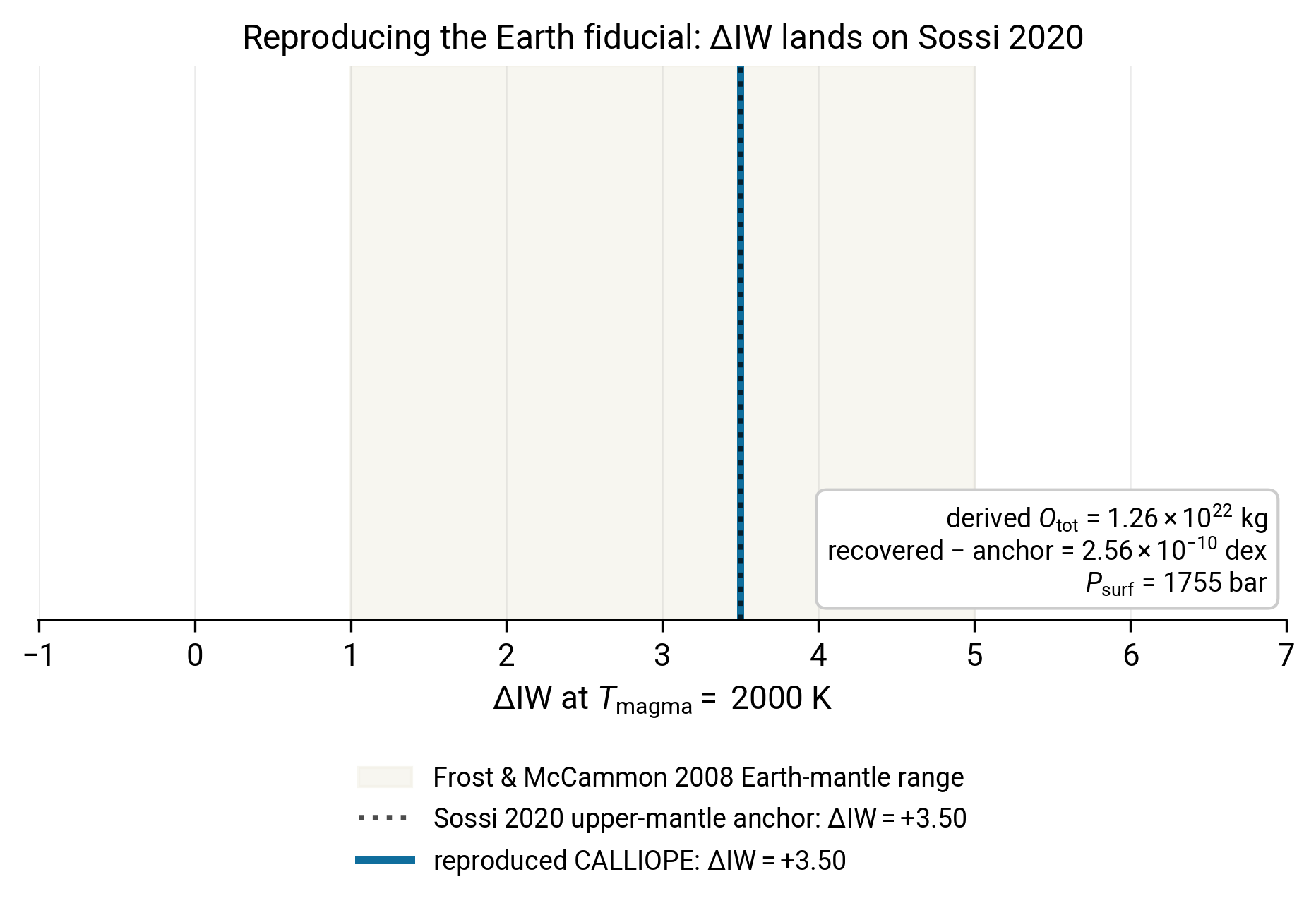
Earth fiducial reproduced from scratch. The cream band represents the Frost & McCammon 2008 1 empirical Earth-mantle range, \(\Delta\mathrm{IW} \in [+1, +5]\) (a conversion of their stated FMQ \(\pm 2\) dex upper-mantle window onto the IW reference). The dotted vertical is the Sossi et al. 2020 3 upper-mantle anchor, \(\Delta\mathrm{IW} = +3.50\). The solid line is the CALLIOPE recovered value after the buffered \(\to\) authoritative-O round-trip. The summary box reports the derived O budget, the absolute closure residual (a few parts in \(10^9\)), and the converged surface pressure. The reproduced CALLIOPE line sits exactly on the Sossi anchor, as it should: the entire workflow is constructed to land on this value.
If your reproduced figure does not show the CALLIOPE line on the Sossi anchor, the most likely cause is that you skipped the canonical_guess in Step 2 and the buffered solver landed in the spurious H\(_2\)O-free basin. Add the p_guess and re-run.
Where to go next
- For the full atmosphere-side details (every partial pressure at this fiducial), open the First-run reference figure and substitute these inputs.
- For how this fiducial sits inside the cross-backend story (CALLIOPE vs atmodeller at the same inputs), read the Backend comparison explanation page.
- For the planetary case study that contrasts Earth-BSE with a very different inventory, read the next tutorial: Mars-like atmosphere.
Reproducing the figure
Generated by scripts/tutorials/fig_earth_fiducial.py. Re-run with python -m scripts.tutorials.fig_earth_fiducial from the repository root.
-
D. J. Frost, C. A. McCammon, The redox state of Earth's mantle, Annual Review of Earth and Planetary Sciences, 36, 389, 2008. ↩
-
S. Krijt, M. Kama, M. McClure, J. Teske, E. A. Bergin, O. Shorttle, K. J. Walsh, S. N. Raymond, Chemical habitability: supply and retention of life's essential elements during planet formation, in Protostars and Planets VII, S. Inutsuka, Y. Aikawa, T. Muto, K. Tomida, M. Tamura, eds., Astronomical Society of the Pacific Conference Series, 534, 1031, 2023. ↩
-
P. A. Sossi, A. D. Burnham, J. Badro, A. Lanzirotti, M. Newville, H. St. C. O'Neill, Redox state of Earth's magma ocean and its Venus-like early atmosphere, Science Advances, 6, eabd1387, 2020. ↩↩