Backend comparison
PROTEUS supports two outgassing backends with an authoritative-O entry point: CALLIOPE and atmodeller. Both invert the same closure (the user-supplied O budget is the volatile O that participates in atmospheric and dissolved chemistry; the IW-buffer offset \(\Delta\mathrm{IW}\) becomes the fifth unknown), but they implement it with different IW-buffer parameterisations, different solubility-law selections, different gas-phase equation-of-state choices, and different solver architectures.
This page quantifies where the two backends agree and where they disagree, so that a user picking a backend for a coupled run can reason about the systematic that choice implies.
The atmodeller results on this page were produced with atmodeller v1.0.0. atmodeller is under active development, so a later release may shift the comparison; the version is recorded here so the figures can be reproduced or re-checked against it.
The figures here are regenerated by the reusable scripts in scripts/cross_backend/; see Reproducing this page at the end.
The Earth fiducial used throughout this page
A cross-backend comparison only carries meaning if both solvers are fed the same inputs. Figures 3, 4, and 5 all run both backends at one shared Earth fiducial so that any disagreement they show is attributable to the backends' internal choices (buffer, solubility, EOS, equilibrium-constant fits) rather than to a difference in the inputs. The fiducial is Earth bulk-silicate-Earth (BSE), \(\Phi = 1\), with \(T_\mathrm{magma}\) either fixed at 2000 K (Figures 4 and 5) or swept from 1800 K to 3000 K (Figure 3). Earth is the natural anchor because the modern upper-mantle \(\Delta\mathrm{IW}\) is empirically constrained (Sossi et al. 2020 12; Frost & McCammon 2008 5), which lets us check in Figure 5 whether either backend's prediction lands inside the petrologically allowed range.
The H / C / N / S inputs come from the Krijt et al. 2023 10 Protostars and Planets VII Tables 1 and 2 BSE row, summed across mantle and atmospheric reservoirs:
| Element | Krijt+2023 BSE mass (kg) |
|---|---|
| H | \(5.6 \times 10^{20}\) |
| C | \(3.1 \times 10^{21}\) |
| N | \(3.7 \times 10^{19}\) |
| S | \(1.0 \times 10^{21}\) |
Oxygen is not taken from Krijt et al. 2023 directly.
Krijt's tabulated O is a redox-active inventory (the mass of O required to move BSE to the Fe(II)O reference state, dominated by the mantle FeO / Fe\(_2\)O\(_3\) imbalance), whereas the authoritative-O entry point treats O as the volatile budget (atoms in atmospheric and dissolved H\(_2\)O / CO\(_2\) / SO\(_2\) / O\(_2\) only).
The two definitions are not interconvertible without a chemistry calculation.
The volatile-O reference used on this page, \(O = 1.26 \times 10^{22}\) kg, was derived by running CALLIOPE in buffered mode at the Krijt H/C/N/S budget above, \(T_\mathrm{magma} = 2000\) K, and the Sossi 2020 12 \(\Delta\mathrm{IW} = +3.5\) Earth-upper-mantle anchor with the current default Fischer 2011 buffer.
The provenance function scripts/cross_backend/inventories.derive_earth_volatile_O() re-derives this number from scratch on demand.
Sources of disagreement
Four axes contribute to cross-backend \(\Delta\mathrm{IW}\) disagreement. Two can be aligned at the wrapper level, two cannot.
| Axis | CALLIOPE | atmodeller | Aligned by default? |
|---|---|---|---|
| IW buffer | Fischer et al. 2011 6 (current default, see below); O'Neill & Eggins 2002 11 available as legacy 'oneill' |
Hirschmann composite (Hirschmann et al. 2008 8 below 1000 K, Hirschmann 2021 9 above) | Close (Fischer is within ~0.2 dex of Hirschmann across the magma-ocean range) |
| H\(_2\)O solubility | Sossi et al. 2023 13 peridotite | H2O_peridotite_sossi23 |
Yes |
| CO\(_2\) solubility | Dixon et al. 1995 4 basalt | CO2_basalt_dixon95 |
Yes |
| N\(_2\) solubility | Dasgupta et al. 2022 3 | N2_basalt_dasgupta22 |
Yes |
| S\(_2\) solubility | Gaillard et al. 2022 7 sulfide-only | S2_sulfide_basalt_boulliung23 (Boulliung & Wood 2023 1, CoMP) |
No |
| H\(_2\), CO, CH\(_4\) solubility | identically zero (Bower et al. 2022 2 §2.2.3) | Hirschmann 2012, Yoshioka 2019, Ardia 2013 | Optionally (set keys to none) |
| Gas-phase EOS | ideal | ideal by default; real-gas selectable | Yes (with EOS off) |
| Equilibrium constants | JANAF + Schaefer-Fegley fits | atmodeller thermodata | No |
| Solver | scipy fsolve + trust-constr with Monte-Carlo restart |
JAX gradient-based with multistart | Different by construction; affects convergence behaviour, not converged answer |
Buffer convention as a cross-backend systematic
CALLIOPE's default IW buffer is Fischer et al. 2011 6, with O'Neill & Eggins 2002 11 available as OxygenFugacity('oneill') for backwards compatibility. atmodeller uses the Hirschmann composite (Hirschmann 2008 below 1000 K, Hirschmann 2021 above). Across magma-ocean temperatures O'Neill and Hirschmann differ by up to \(\sim 1\) dex; Fischer and Hirschmann agree to within \(\sim 0.2\) dex over the same range, so the cross-backend buffer offset under the current default is much smaller than under the legacy choice.
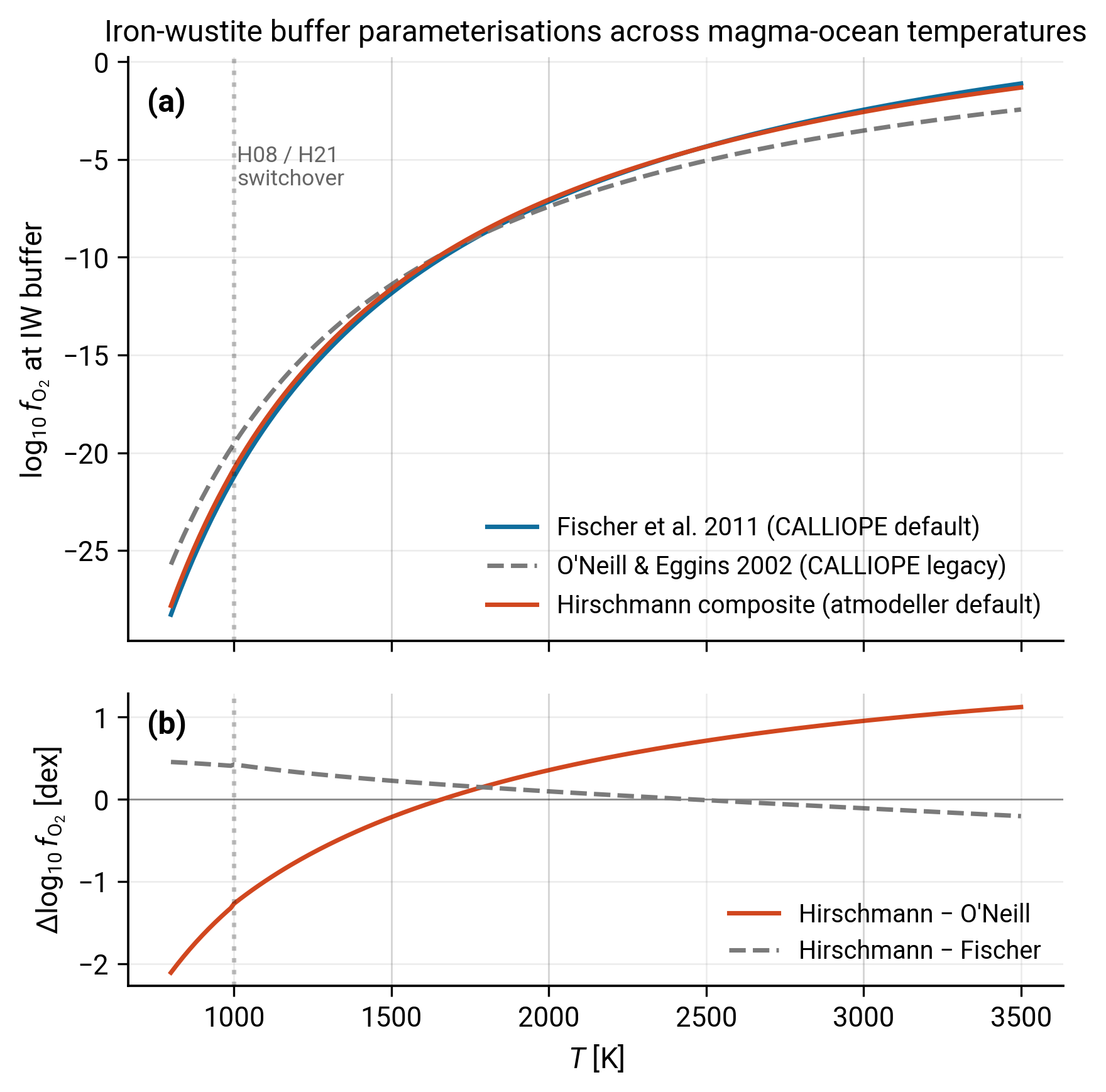
Figure 1. (a) IW-buffer parameterisations across magma-ocean temperatures. The Hirschmann composite switches from Hirschmann 2008 to Hirschmann 2021 at 1000 K, which produces a kink that the monolithic parameterisations do not have. (b) Difference between Hirschmann composite and the two CALLIOPE options, in dex. At \(T = 3000\) K the Hirschmann buffer is \(0.95\) dex more oxidising than O'Neill but only \(0.11\) dex below Fischer, an order of magnitude smaller. Fischer 2011 hugs Hirschmann everywhere above \(\sim 1700\) K.
The buffer choice therefore moves the default residual from \(\sim 1\) dex (with the legacy O'Neill setting) down to \(\lesssim 0.2\) dex (with the Fischer default). The remaining cross-backend disagreement is genuinely chemistry-level (solubility laws, equilibrium-constant fits) rather than buffer-level.
Each backend is internally self-consistent
Before comparing backends to each other, each must round-trip self-consistently: start from a buffered-mode call at a known \(\Delta\mathrm{IW}\), take the resulting O budget, feed it back into the authoritative-O entry point, and recover the input \(\Delta\mathrm{IW}\). We sweep \(T_\mathrm{magma}\) because the chemistry itself is temperature-dependent: the equilibrium constants are evaluated at \(T\), the Dasgupta nitrogen solubility carries explicit \(T\) and \(f_{\mathrm{O}_2}\) terms, and the Gaillard sulfur solubility carries an explicit \(f_{\mathrm{O}_2}\) term. A round-trip that only worked at one \(T\) would not be evidence of internal consistency; the test must cover the full range where the calibrated chemistry is meant to apply.
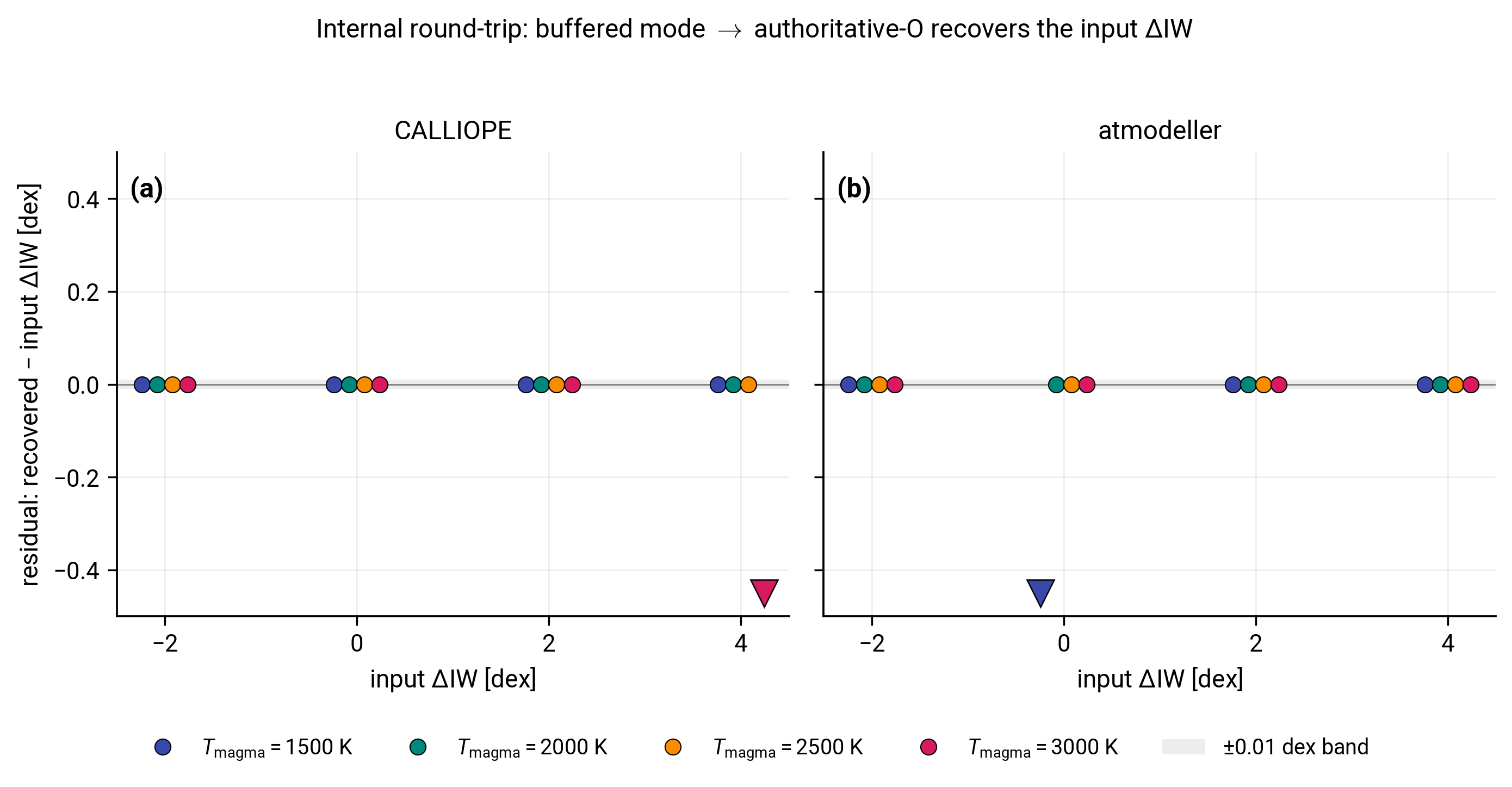
Figure 2. Round-trip residuals \(\Delta\mathrm{IW}_\mathrm{recovered} - \Delta\mathrm{IW}_\mathrm{input}\) for each backend at \(T_\mathrm{magma} \in \{1500, 2000, 2500, 3000\}\,\mathrm{K}\) and input \(\Delta\mathrm{IW} \in \{-2, 0, +2, +4\}\). Coloured circles map to the four temperatures (cool to warm); horizontal jitter is added so the four temperature markers fan out at each input \(\Delta\mathrm{IW}\) rather than stacking. The grey band marks the \(\pm 0.01\) dex solver tolerance. (a) CALLIOPE: all but one grid point sit well inside the tolerance band; the magenta triangle at the bottom right marks the one edge case where the authoritative-O solver landed in a secondary basin and returned \(\Delta\mathrm{IW}_\mathrm{recovered} = -5.84\) from an input of \(+4\) at \(T = 3000\) K. (b) atmodeller: all converged grid points are inside the tolerance band; the indigo triangle at the bottom of panel (b) marks the one grid point where the solver failed to converge (\(T = 1500\) K, input \(\Delta\mathrm{IW} = 0\)).
Internal consistency holds across the bulk of the \((T, \Delta\mathrm{IW})\) grid relevant to terrestrial magma oceans. The two off-scale points are solver-edge cases at the corners of the swept range and are flagged honestly rather than masked. They do not affect the cross-backend comparison in Figure 3, which is run at one Earth-volatile-rich fiducial well inside the well-behaved region of each solver.
Cross-backend agreement on the chemistry
With internal consistency confirmed, the cross-backend \(\Delta\mathrm{IW}\) disagreement at matched inputs is the interesting quantity. Both backends are run at the Krijt et al. 2023 10 BSE H/C/N/S inventory with the volatile O reference set by a CALLIOPE buffered-mode call at \(\Delta\mathrm{IW} = +3.5\) (the Sossi 2020 12 Earth upper-mantle anchor). Sweeping \(T_\mathrm{magma}\) from 1800 K to 3000 K, with \(\Phi = 1\) throughout, gives:
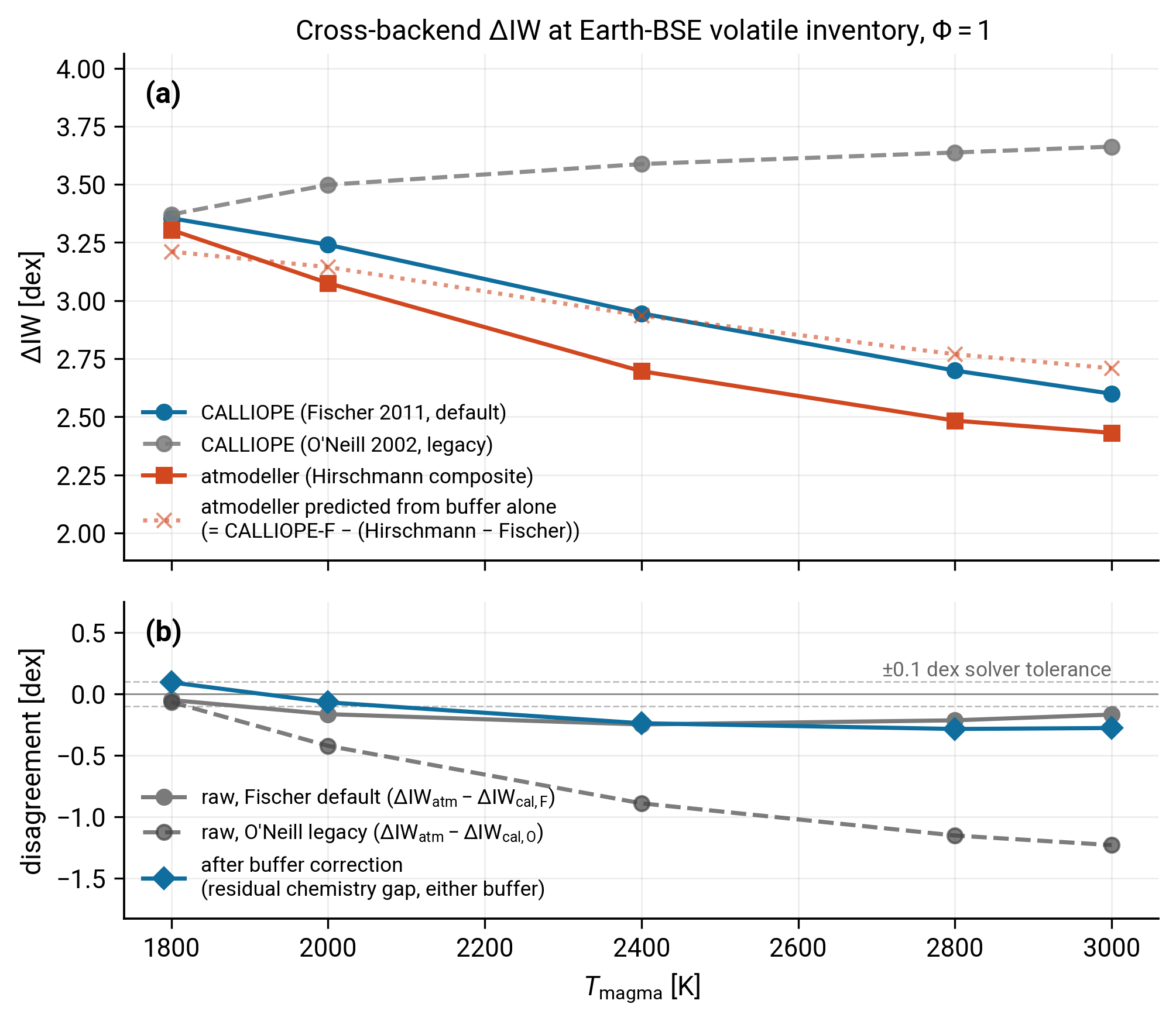
Figure 3. (a) Converged \(\Delta\mathrm{IW}\) from each backend across \(T_\mathrm{magma}\) at fixed Earth-BSE Krijt+2023 volatile inventory and \(\Phi = 1\). Solid blue circles: CALLIOPE with the current default Fischer 2011 buffer. Dashed grey: CALLIOPE with the legacy O'Neill 2002 buffer. Solid red squares: atmodeller (Hirschmann composite). The dotted red curve is CALLIOPE-F's \(\Delta\mathrm{IW}\) minus the analytical Hirschmann-minus-Fischer offset at the same \(T\): it is where atmodeller would land if the two backends used identical chemistry and the buffer was the only difference. (b) Two raw cross-backend gaps and the buffer-corrected residual. Solid grey: raw \(\Delta\mathrm{IW}_\mathrm{atm} - \Delta\mathrm{IW}_\mathrm{CALLIOPE,F}\). Dashed grey: raw gap against the legacy O'Neill buffer. Solid blue diamonds: residual after the analytical buffer correction (numerically the same for either buffer, by construction). Dashed lines bracket the \(\pm 0.1\) dex solver tolerance.
Panel (a) shows the dashed legacy curve (O'Neill) drifting away from atmodeller as \(T\) rises, while the solid default curve (Fischer) hugs atmodeller within a few tenths of a dex everywhere on the sweep. Panel (b) makes this precise: the raw \(\Delta\mathrm{IW}\) gap with the legacy buffer grows from \(-0.07\) dex at \(T = 1800\) K to \(-1.23\) dex at \(T = 3000\) K, while the same gap with the Fischer default never exceeds \(-0.25\) dex in magnitude across the same range. The buffer-corrected residual (which subtracts the analytical Hirschmann-minus-buffer offset and is therefore independent of which buffer CALLIOPE used) stays within \(\pm 0.1\) dex at \(T \le 2000\) K and reaches about \(-0.28\) dex at the hottest end. At the cold end of the sweep (\(T \le 2000\) K) the Fischer raw gap is comparable to or smaller than the residual chemistry gap; above \(\sim 2000\) K the residual chemistry gap dominates, consistent with the S\(_2\) sulfate-regime divergence between Gaillard 2022 and Boulliung & Wood 2023 becoming larger at hotter, more oxidising conditions. Either way the cross-backend disagreement has dropped from "buffer-dominated, up to 1 dex" with the legacy default to "chemistry-dominated, a few tenths of a dex" with the new default.
A wider 2D sweep over O budget was attempted first and abandoned: the authoritative-O entry point has a documented non-monotonic regime at sub-trace O budgets where the residual surface develops a second root and a basin-selection sensitivity dominates over the cross-backend physics signal. Inside the regime where both backends consistently land in the oxidising basin (the physically expected regime for terrestrial inventories), the comparison is the one shown above.
Attribution of residual disagreement
A bar-chart breakdown of the cross-backend gap at the canonical Earth fiducial isolates which alignment moves dominate.
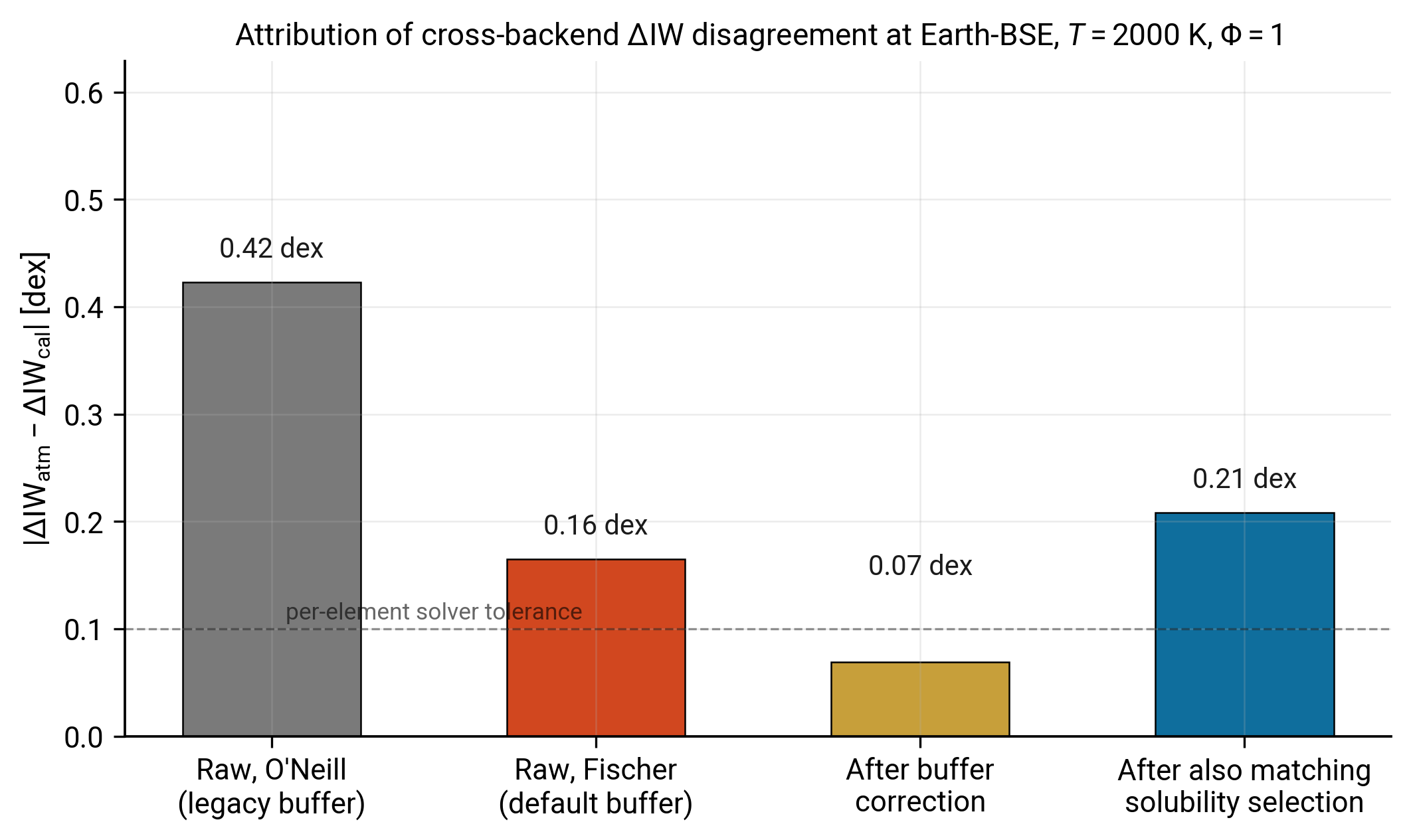
Figure 4. \(|\Delta\mathrm{IW}_\mathrm{atmodeller} - \Delta\mathrm{IW}_\mathrm{CALLIOPE}|\) at the canonical Earth fiducial, in four configurations of increasing alignment. Bar 1 is the raw disagreement under the legacy O'Neill 2002 buffer. Bar 2 is the raw disagreement under the current Fischer 2011 default; the drop from bar 1 to bar 2 is what the buffer-default change buys for free. Bar 3 removes the residual buffer contribution by subtracting the analytical Hirschmann-minus-Fischer offset. Bar 4 additionally forces atmodeller to disable H\(_2\) / CO / CH\(_4\) solubility, matching CALLIOPE's Bower 2022 §2.2.3 convention. The dashed line marks the per-element solver tolerance.
The raw disagreement of \(0.42\) dex at this fiducial under the legacy buffer falls to \(0.16\) dex with the Fischer default, just above the per-element solver tolerance. The analytical buffer correction takes it the rest of the way: \(0.07\) dex, below tolerance. Forcing the H\(_2\) / CO / CH\(_4\) solubility alignment moves atmodeller's converged \(\Delta\mathrm{IW}\) enough to grow the disagreement back to \(0.21\) dex; that move shows that atmodeller's H\(_2\) / CO / CH\(_4\) solubility defaults were partially compensating for the buffer-convention difference, and removing them surfaces a small chemistry-level mismatch that is otherwise hidden. The takeaway after the buffer-default change is that the as-shipped disagreement is now at the few-tenths-of-a-dex level, dominated by the remaining solubility-law differences (S\(_2\) above all) rather than by the IW-buffer choice.
Comparison against the Earth anchor
Both backends produce a \(\Delta\mathrm{IW}\) from the Krijt+2023 10 BSE H/C/N/S inventory (with volatile O derived self-consistently at the Sossi 2020 \(\Delta\mathrm{IW} = +3.5\) baseline). The empirical anchor for Earth's modern upper mantle is the Frost & McCammon (2008) 5 range \(\Delta\mathrm{IW} \in [+1, +5]\) (FMQ-3 to FMQ+1), with the Sossi et al. 2020 12 best estimate at \(+3.5\).
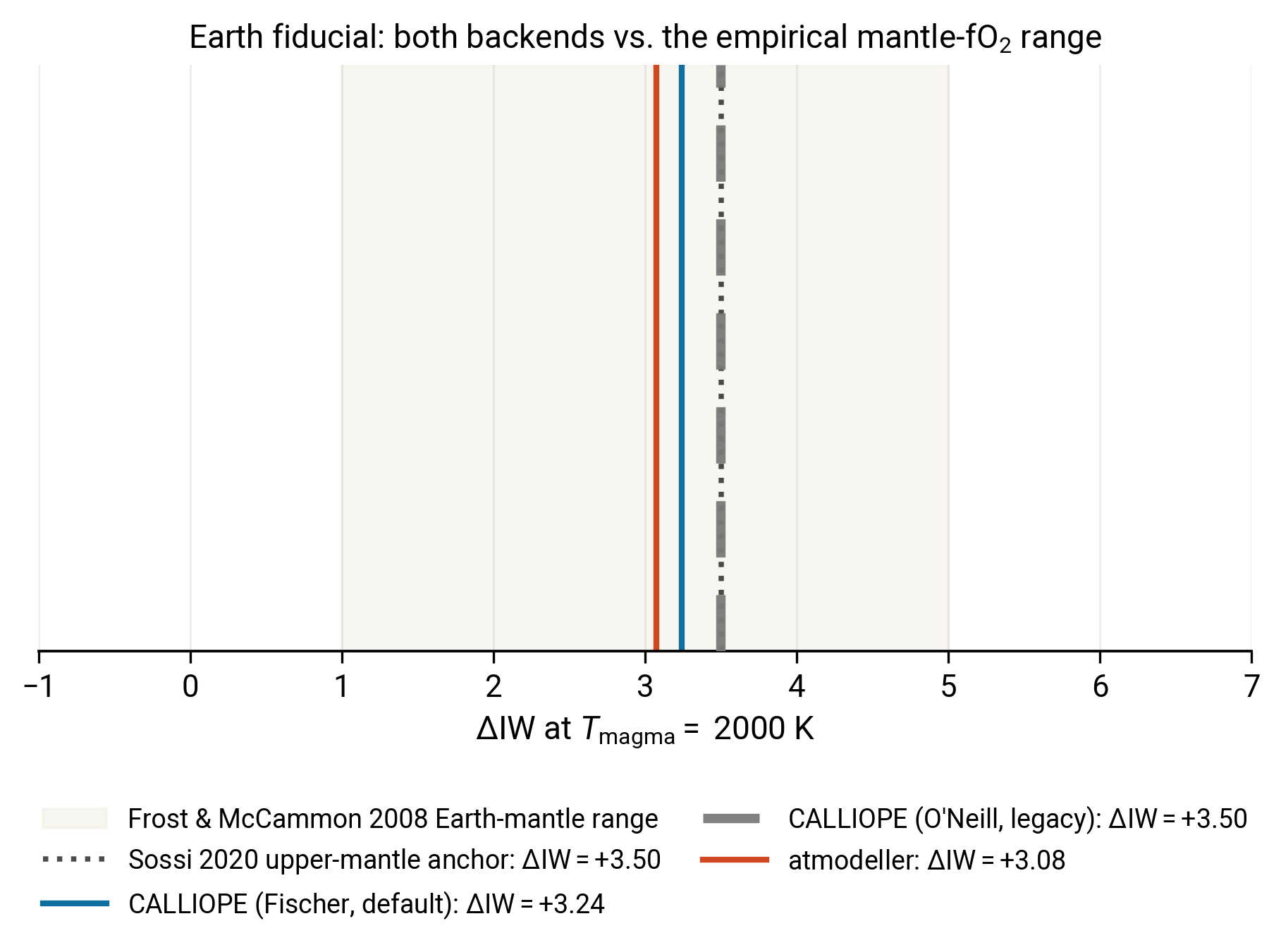
Figure 5. Each backend's converged \(\Delta\mathrm{IW}\) at the Earth fiducial, overlaid on the Frost & McCammon 2008 empirical range and the Sossi 2020 best estimate. Solid blue: CALLIOPE with the Fischer 2011 default. Dashed grey: CALLIOPE with the legacy O'Neill 2002 buffer (recovers \(+3.50\) by construction because the volatile-O reference was derived from a CALLIOPE-O'Neill buffered call at this state). Solid red: atmodeller. With the Fischer default CALLIOPE lands at \(\Delta\mathrm{IW} \approx +3.24\), between atmodeller and Sossi 2020; the CALLIOPE-vs-atmodeller gap is now \(0.16\) dex rather than the legacy \(0.42\) dex.
All three backend points fall inside the empirical Frost & McCammon range. Neither parameterisation is in tension with petrology at this single fiducial; the cross-backend gap, even before the analytical buffer correction, is now well inside the petrological uncertainty on Earth's mantle \(\Delta\mathrm{IW}\).
Choosing a backend for your study
With the Fischer 2011 default in place, the as-shipped CALLIOPE and atmodeller backends agree to a few tenths of a dex in \(\Delta\mathrm{IW}\) across the magma-ocean range. The dominant residual is now the chemistry-level disagreement (S\(_2\) solubility law above all), not the IW-buffer choice. The practical implications are:
- Either default backend is defensible. With Fischer 2011 in CALLIOPE and Hirschmann in atmodeller, the cross-backend \(\Delta\mathrm{IW}\) gap at Earth-like inputs is \(\sim 0.16\) dex at \(T = 2000\) K and stays below \(\sim 0.3\) dex up to \(T = 3000\) K. Either reading is well inside the petrological uncertainty on Earth's mantle.
- Still pick one backend per coupled study. Cross-backend \(\Delta\mathrm{IW}\) values from the two solvers are not bit-identical, and mixing them inside one coupled run will introduce a few-tenths-of-a-dex drift. PROTEUS' helpfile records
fO2_shift_IW_derivedfrom the active backend; treat that column as backend-faithful, not cross-backend comparable. - If you need to reproduce legacy results, set CALLIOPE to the O'Neill buffer (
OxygenFugacity('oneill')). The legacy choice reproduces the older numbers verbatim; expect a \(\sim 0.2\) to \(\sim 1.0\) dex offset against atmodeller depending on \(T\). - For oxidising-mantle work above FMQ (\(\Delta\mathrm{IW} \gtrsim +3\)), the dominant sub-buffer disagreement is the S\(_2\) channel. atmodeller's Boulliung & Wood 2023 law captures sulfate dissolution that Gaillard 2022 cannot; if your study turns on sulfur partitioning at oxidising conditions, prefer atmodeller.
- When running in authoritative-O mode (
planet.fO2_source = "from_O_budget"), confirm that the backend you pick has consistent O accounting end-to-end: the derived \(\Delta\mathrm{IW}\), the partial pressures, and the dissolved masses should all close back to the user O budget within solver tolerance. The authoritative-oxygen page describes the inputs and outputs.
Reproducing this page
Every figure on this page is regenerated by the scripts in scripts/cross_backend/. To re-run:
# From the CALLIOPE repository root, with calliope and atmodeller installed
bash scripts/cross_backend/run_all.sh
Per-figure regeneration: python3 -m scripts.cross_backend.fig3_grid and similarly for the other figures.
The scripts write PDF and PNG outputs to docs/assets/figures/cross_backend/ and raw CSV data to scripts/cross_backend/data/. Approximate total wall time on a modern Mac is twenty minutes, dominated by the atmodeller authoritative-O solver calls (~15 s warm, ~60 s cold first JAX compile per process).
The scripts are reusable for different fiducials, different inventories, or different alignment configurations; see scripts/cross_backend/README.md for the extension pattern.
See also
- Authoritative-oxygen mode: the entry-point shared by both backends.
- Oxygen fugacity: the four channels through which \(\Delta\mathrm{IW}\) enters the chemistry.
- Solubility laws: per-species validity envelopes for CALLIOPE's solubility selection.
- Coupling to PROTEUS: how the PROTEUS wrapper selects between backends at runtime.
- atmodeller documentation: the canonical upstream reference for the second backend.
-
J. Boulliung, B. J. Wood, Sulfur oxidation state and solubility in silicate melts, Contributions to Mineralogy and Petrology, 178(8), 56, 2023. SciX. ↩
-
D. J. Bower, K. Hakim, P. A. Sossi, P. Sanan, Retention of water in terrestrial magma oceans and carbon-rich early atmospheres, The Planetary Science Journal, 3(4), 93, 2022. SciX. ↩
-
R. Dasgupta, E. Falksen, A. Pal, C. Sun, The fate of nitrogen during parent body partial melting and accretion of the inner Solar System bodies at reducing conditions, Geochimica et Cosmochimica Acta, 336, 291–307, 2022. SciX. ↩
-
J. E. Dixon, E. M. Stolper, J. R. Holloway, An experimental study of water and carbon dioxide solubilities in mid-ocean ridge basaltic liquids. Part I: Calibration and solubility models, Journal of Petrology, 36(6), 1607–1631, 1995. SciX. ↩
-
D. J. Frost, C. A. McCammon, The redox state of Earth's mantle, Annual Review of Earth and Planetary Sciences, 36, 389–420, 2008. SciX. ↩↩
-
R. A. Fischer, A. J. Campbell, G. A. Shofner, O. T. Lord, P. Dera, V. B. Prakapenka, Equation of state and phase diagram of FeO, Earth and Planetary Science Letters, 304(3), 496–502, 2011. ↩↩
-
F. Gaillard, F. Bernadou, M. Roskosz, M. A. Bouhifd, Y. Marrocchi, G. Iacono-Marziano, M. Moreira, B. Scaillet, G. Rogerie, Redox controls during magma ocean degassing, Earth and Planetary Science Letters, 577, 117255, 2022. SciX. ↩
-
M. M. Hirschmann, M. S. Ghiorso, F. A. Davis, S. M. Gordon, S. Mukherjee, T. L. Grove, M. Krawczynski, E. Médard, C. B. Till, Library of Experimental Phase Relations (LEPR): a database and Web portal for experimental magmatic phase equilibria data, Geochemistry, Geophysics, Geosystems, 9(3), Q03011, 2008. SciX. ↩
-
M. M. Hirschmann, Iron-wüstite revisited: a revised calibration accounting for variable stoichiometry and the effects of pressure, Geochimica et Cosmochimica Acta, 313, 74–84, 2021. SciX. ↩
-
S. Krijt, M. Kama, M. McClure, J. Teske, E. A. Bergin, O. Shorttle, K. J. Walsh, S. N. Raymond, Chemical habitability: supply and retention of life's essential elements during planet formation, in Protostars and Planets VII, S. Inutsuka, Y. Aikawa, T. Muto, K. Tomida, M. Tamura, eds., Astronomical Society of the Pacific Conference Series, 534, 1031, 2023. SciX. ↩↩↩
-
H. St. C. O'Neill, S. M. Eggins, The effect of melt composition on trace element partitioning: an experimental investigation of the activity coefficients of FeO, NiO, CoO, MoO\(_2\) and MoO\(_3\) in silicate melts, Chemical Geology, 186, 151–181, 2002. SciX. ↩↩
-
P. A. Sossi, A. D. Burnham, J. Badro, A. Lanzirotti, M. Newville, H. St. C. O'Neill, Redox state of Earth's magma ocean and its Venus-like early atmosphere, Science Advances, 6, eabd1387, 2020. SciX. ↩↩↩↩
-
P. A. Sossi, P. M. E. Tollan, J. Badro, D. J. Bower, Solubility of water in peridotite liquids and the prevalence of steam atmospheres on rocky planets, Earth and Planetary Science Letters, 601, 117894, 2023. SciX. ↩