Binodal (Miscibility) Suppression
This page documents the binodal suppression models used in Zalmoxis for multi-component mixtures involving molecular hydrogen. When H\(_2\) is mixed with silicate (MgSiO\(_3\)) or water (H\(_2\)O) in a mantle layer, the binodal determines whether H\(_2\) is thermodynamically miscible with its partner at each local \((P, T)\) condition. Below the binodal temperature, H\(_2\) is immiscible and should not contribute to the structural density. Above the binodal, H\(_2\) is miscible and participates in the harmonic mean.
For configuration syntax, see the configuration guide. For the density-based sigmoid suppression (the other half of the total suppression), see the mixing documentation.
Motivation
In sub-Neptune interiors, H\(_2\) can be dissolved into the silicate magma at high temperatures and pressures. This is a fundamentally different physical regime from the traditional core-envelope structure: instead of a sharp boundary between a rocky interior and a gaseous envelope, the composition varies continuously with depth. The binodal (miscibility boundary) defines the \((P, T)\) conditions where the single-phase miscible state becomes thermodynamically unstable and separates into two coexisting phases (H\(_2\)-rich gas and silicate-rich melt).
Without binodal suppression, the density-based sigmoid alone would include H\(_2\) in the harmonic mean whenever its density exceeds the critical density (~31 kg/m\(^3\)), even at temperatures where H\(_2\) and silicate are immiscible and should exist as separate phases. The binodal sigmoid adds a physically motivated temperature criterion.
Total suppression weight
For an H\(_2\) component in a mixture, the total suppression weight is:
where:
- \(\sigma_{\mathrm{density}}\) is the density-based sigmoid with per-component parameters (
condensed_rho_min= 30 kg/m\(^3\),condensed_rho_scale= 10 kg/m\(^3\) for H\(_2\)). - \(\sigma_{\mathrm{binodal}}\) is the temperature-based sigmoid centered on the binodal temperature \(T_\mathrm{b}(P)\):
The binodal_T_scale parameter (default 50 K) controls the transition width.
When multiple binodal models apply (H\(_2\) mixed with both silicate and water), the most restrictive suppression weight (the minimum) is used. For non-H\(_2\) components, \(\sigma_{\mathrm{binodal}} = 1\) always.
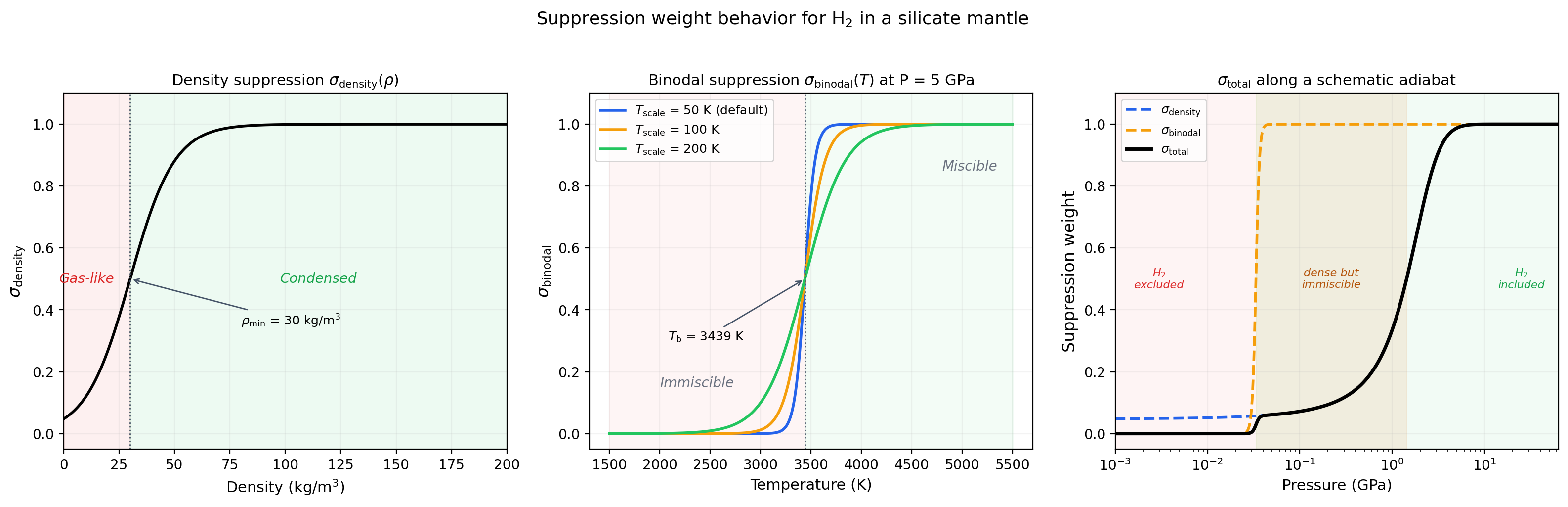
Left: the density-based sigmoid \(\sigma_{\mathrm{density}}(\rho)\) for H\(_2\) (center at 30 kg/m\(^3\)). At low density (gas-like), H\(_2\) is excluded from the harmonic mean. Center: the binodal sigmoid \(\sigma_{\mathrm{binodal}}(T)\) at fixed pressure, showing the transition from immiscible (below \(T_\mathrm{b}\)) to miscible (above \(T_\mathrm{b}\)) for three binodal_T_scale values. Right: the combined weight \(\sigma_{\mathrm{total}}\) along a representative planetary adiabat. At depth (high P), both conditions are met and H\(_2\) participates fully. Near the surface, either low density or the binodal transition suppresses H\(_2\).
Rogers+2025: H\(_2\)-MgSiO\(_3\) binodal
Source
Rogers, Young & Schlichting (2025), MNRAS 544, 3496. Analytic fit to the binodal temperature \(T_\mathrm{b}(x_{\mathrm{H_2}}, P)\) from Eqs. A1-A11. Based on DFT-MD calculations of H\(_2\)-MgSiO\(_3\) miscibility and asymmetric Margules parameters from Gilmore & Stixrude (2026).
Physics
The binodal defines the phase boundary in \((T, P, x_{\mathrm{H_2}})\) space between:
- Above the binodal: a single miscible supercritical phase where H\(_2\) and MgSiO\(_3\) mix at the molecular level.
- Below the binodal: two immiscible phases (H\(_2\)-rich gas and silicate-rich melt) that separate gravitationally.
The binodal temperature is computed from two generalized logistic branches: an ascending branch (small \(x_{\mathrm{H_2}}\), rising toward \(T_\mathrm{c}\)) and a descending branch (large \(x_{\mathrm{H_2}}\), falling from \(T_\mathrm{c}\)). Their natural crossing occurs near the critical mole fraction \(x_\mathrm{c} \approx 0.739\). The implementation evaluates both branches at every composition and takes the minimum, \(T_\mathrm{b} = \min(T_{\mathrm{asc}}, T_{\mathrm{desc}})\), which produces a smooth peak without an artificial kink at \(x_\mathrm{c}\).
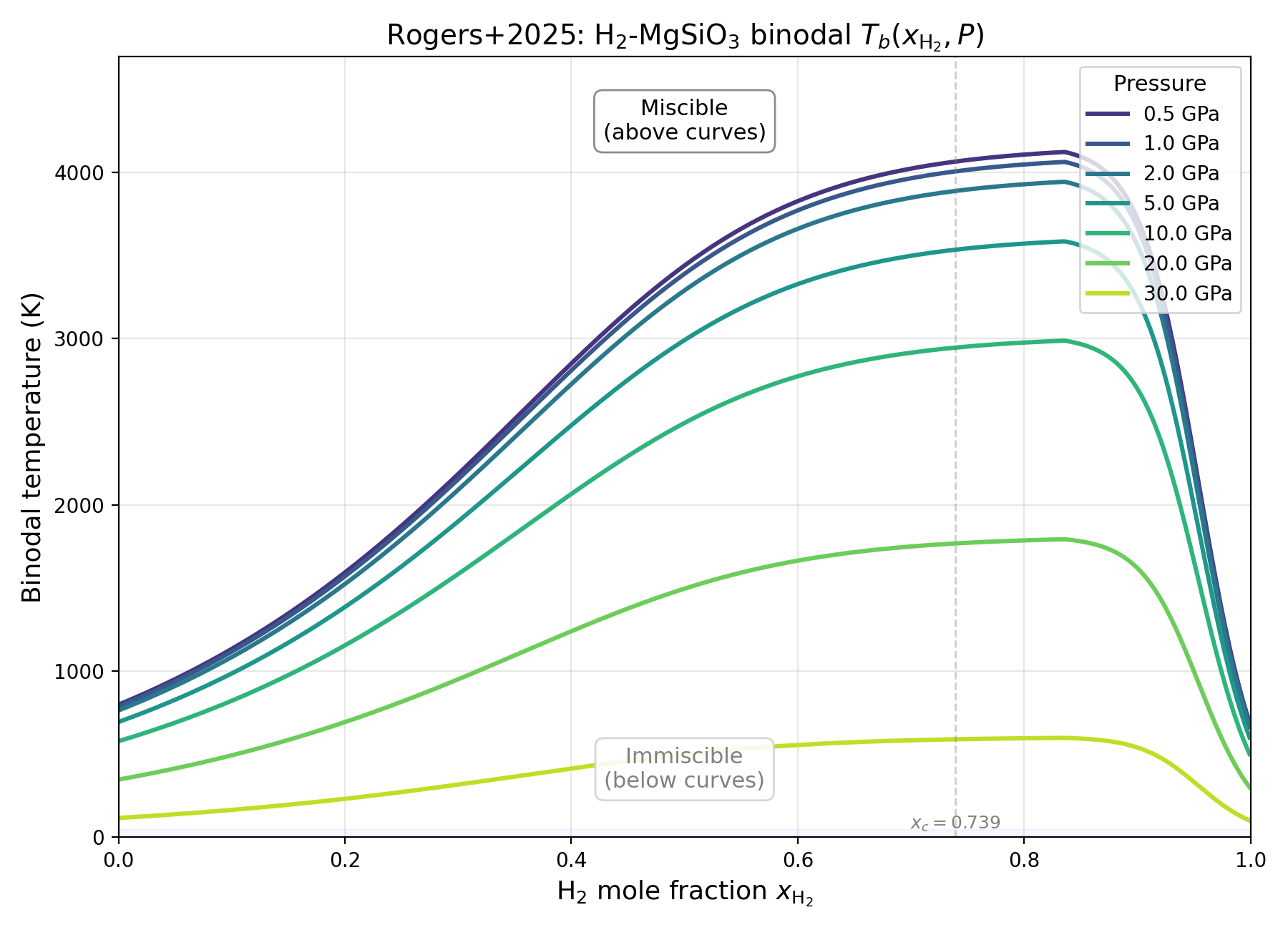
Binodal temperature \(T_\mathrm{b}\) as a function of H\(_2\) mole fraction at seven pressures (0.5 to 30 GPa). The binodal drops with increasing pressure: at high P, H\(_2\) and MgSiO\(_3\) are compressed together and miscibility is easier. At P > 35 GPa, \(T_\mathrm{c} < 0\) and the system is always miscible. The peak near \(x_\mathrm{c} = 0.739\) (5.4% H\(_2\) by mass) is the most difficult composition to mix.
Pressure dependence
The critical temperature \(T_\mathrm{c}\) at the binodal peak decreases linearly with pressure:
| Pressure | Peak \(T_\mathrm{b}\) | Interpretation |
|---|---|---|
| 1 GPa | ~4100 K | Shallow mantle: H\(_2\) miscible only at very high \(T\) |
| 10 GPa | ~3020 K | Mid-mantle: miscibility requires moderate \(T\) |
| 35 GPa | 0 K | Always miscible at any temperature |
Above 35 GPa, the binodal vanishes entirely, and H\(_2\) and MgSiO\(_3\) are always miscible regardless of temperature. This makes the binodal primarily relevant in the upper mantle of sub-Neptunes.
Composition dependence
The binodal temperature depends on the H\(_2\) mole fraction in the H\(_2\)-MgSiO\(_3\) binary system. Mass fractions from the config (e.g., 0.03 for 3% H\(_2\) by mass) are converted to mole fractions internally using the molar masses (\(\mu_{\mathrm{H_2}} = 2.016\) g/mol, \(\mu_{\mathrm{MgSiO_3}} = 100.39\) g/mol). A 3% mass fraction of H\(_2\) corresponds to a mole fraction of ~0.60.
Implementation
The function rogers2025_binodal_temperature(x_H2, P_GPa) returns the binodal temperature for a given composition and pressure. The suppression weight function rogers2025_suppression_weight(P_Pa, T_K, w_H2, w_sil, T_scale) converts mass fractions to mole fractions, evaluates the binodal, and returns the sigmoid weight.
Gupta+2025: H\(_2\)-H\(_2\)O critical curve
Source
Gupta, Stixrude & Schlichting (2025), ApJL 982, L35. Gibbs free energy model with asymmetric Margules mixing parameters (Eqs. A2-A9, Table 1).
Physics
The model provides the Gibbs free energy of mixing for the H\(_2\)-H\(_2\)O binary system:
where \(y\) is a transformed composition variable accounting for asymmetric mixing (Eq. A3), and \(W(T, P)\) is the Margules interaction parameter:
The critical pressure \(P_\mathrm{c}(T)\) above which the system is always single-phase is given by Eq. A8. The critical temperature at a given pressure is obtained by inverting this relationship.
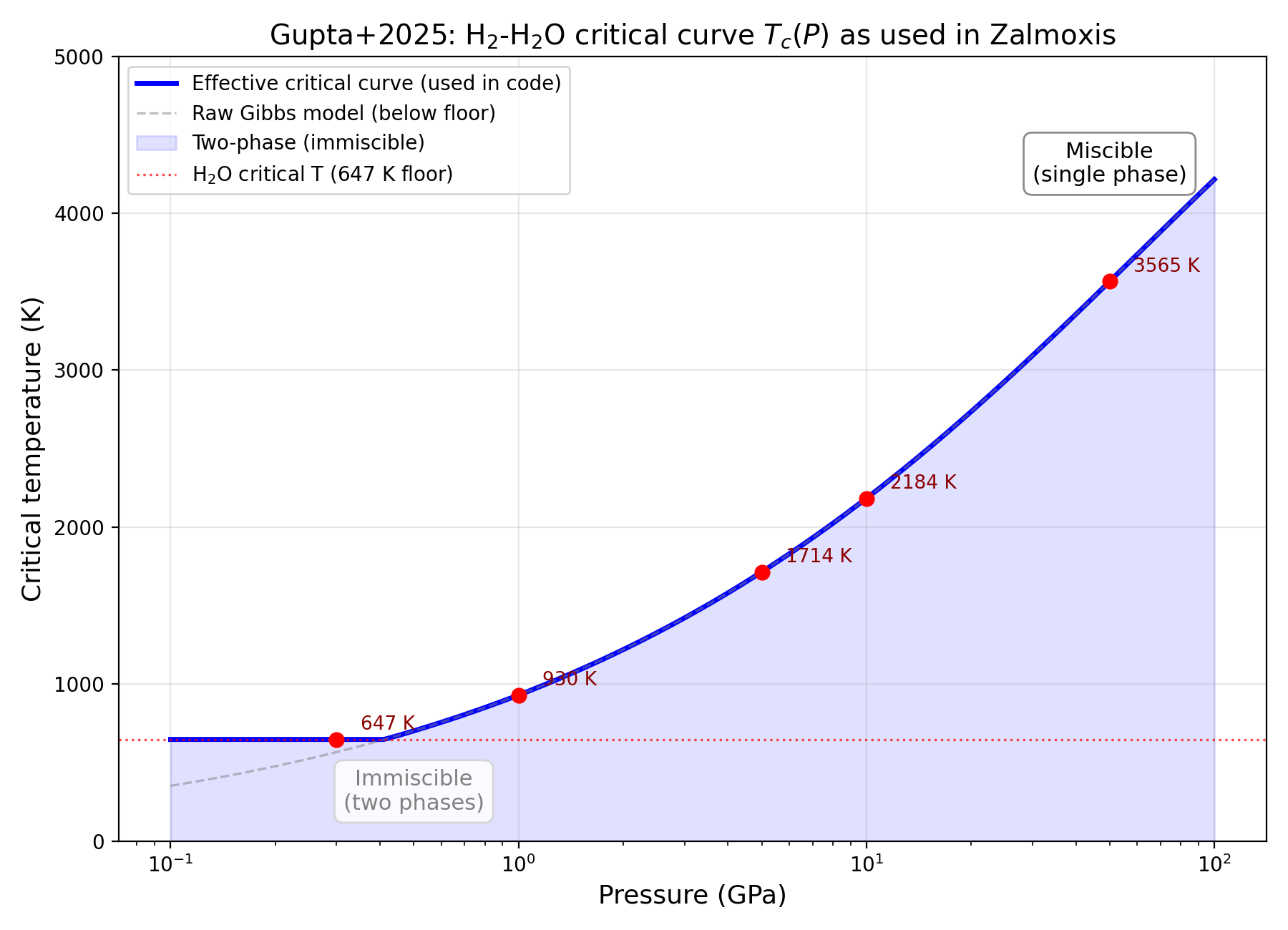
Critical temperature \(T_\mathrm{c}(P)\) for the H\(_2\)-H\(_2\)O system. Below and to the right of the curve (shaded), the system separates into two immiscible phases. Above and to the left, it forms a single homogeneous fluid. The red dotted line marks the 647 K floor imposed by the H\(_2\)O critical point. Note the opposite pressure dependence compared to H\(_2\)-MgSiO\(_3\): higher pressure makes H\(_2\)-H\(_2\)O mixing harder, because the positive volume of mixing favors phase separation under compression.
The 647 K floor
The Gupta+2025 Margules model is fitted to supercritical DFT-MD calculations and is valid only when both H\(_2\) and H\(_2\)O are in supercritical or fluid states. Below 647 K (the critical temperature of pure H\(_2\)O), water condenses to liquid or ice. In this regime:
- The Margules parameters (\(W_V\) and \(\lambda\) have \(1/T^2\) and \(1/T\) dependencies) extrapolate into physically meaningless territory.
- H\(_2\) and condensed H\(_2\)O are always immiscible, regardless of what the Margules model predicts.
A floor of 647 K is imposed on the critical temperature returned by the model. If the Margules-derived critical temperature falls below 647 K, it is replaced by 647 K. This guarantees that H\(_2\) is always suppressed below the H\(_2\)O condensation temperature.
Performance
The critical temperature \(T_\mathrm{c}(P)\) is needed at every ODE step (~150,000 evaluations per structure solve). Rather than calling the Brent root finder each time, a lookup table of 2000 log-spaced pressure points from 1 MPa to ~3 TPa is precomputed at module import time. Each subsequent evaluation is a single np.interp call, falling back to Brent only for out-of-range pressures.
Implementation
The function gupta2025_critical_temperature(P_GPa) returns the critical temperature for a given pressure (with the 647 K floor applied). The suppression weight function gupta2025_suppression_weight(P_Pa, T_K, w_H2, w_H2O, T_scale) evaluates the critical temperature, applies the floor, and returns the sigmoid weight.
The function gupta2025_coexistence_compositions(T, P_GPa) computes the coexisting H\(_2\) mole fractions from a common-tangent construction on the Gibbs energy surface. This is available for diagnostic purposes but is not used in the mixing hot path.
Configuration
All binodal suppression is configured in the [EOS] section of the TOML file.
The only user-facing parameter is binodal_T_scale:
[EOS]
mantle          = "PALEOS:MgSiO3:0.97+Chabrier:H:0.03"
binodal_T_scale = 50.0    # K, sigmoid width for binodal transition
The binodal models are activated automatically when Chabrier:H coexists with MgSiO\(_3\) or H\(_2\)O in the same layer. No additional configuration is needed.
For a sub-Neptune configuration example, see configuration example 4.
Validation
The binodal suppression has been validated against:
- Reproduction of the Rogers+2025 Figure A1 binodal curve.
- Convergence of the structure solver for 5 \(M_\oplus\) planets with 3% H\(_2\) by mass in the mantle.
- Correct behavior at limiting cases: pure endmembers (\(x_{\mathrm{H_2}} = 0\) or \(1\)), high pressure (always miscible above 35 GPa for H\(_2\)-MgSiO\(_3\)), and low temperature (always immiscible below 647 K for H\(_2\)-H\(_2\)O).