Heat transport
Aragog assembles the total radial heat flux at each basic node from four independently configurable contributions:
Each term is gated by a boolean in the [energy] section (conduction, convection, gravitational_separation, mixing); a flux that is disabled is identically zero. Internal heating sources (radiogenic, tidal) are documented separately in Energy equation.
All flux formulas below use the entropy gradient \(\partial S/\partial r\) as the primary driver. Temperature, density, heat capacity, thermal expansivity, and the isentropic temperature gradient \((\partial T/\partial P)_S\) are looked up from the EOS at \((P, S)\) on every RHS evaluation.
Conduction
The Fourier flux is rewritten in entropy form using the thermodynamic identity \(\partial T/\partial r |_S = (T/c_p)\,\partial S/\partial r\) and the EOS-tabulated isentropic temperature gradient:
The pressure gradient is the configured profile (Adams-Williamson or external mesh file). When the entropy gradient vanishes (an isentropic profile) the conduction flux reduces to the adiabatic part alone, which is non-zero because the EOS provides \((\partial T/\partial P)_S\) directly. In the production path with PALEOS tables, \(k\) is read from the EOS as a function of \((P, S)\); the phase_solid.thermal_conductivity and phase_liquid.thermal_conductivity config keys are kept only for the constant-properties analytical mode.
Convection (mixing-length theory)
Convection is parameterised as eddy diffusion of entropy:
The instability criterion is \(\partial S/\partial r < 0\). The \(\max(\cdot, 0)\) form is implemented as a smooth approximation (a \(C^\infty\) ramp) so that the BDF Jacobian remains continuous through the onset of convection. There is no explicit "superadiabatic gradient" subtraction in the entropy formulation: the adiabat corresponds to \(\partial S/\partial r = 0\), so the entropy gradient itself measures departures from the adiabat.
Eddy diffusivity
\(\kappa_h\) is the product of a mixing length \(l(r)\) and a regime-dependent velocity scale. Following Abe (1993)1, Aragog blends the viscous and inviscid limits via a \(\tanh\) on the cell Reynolds number:
with \(\mathrm{Re} = v_\mathrm{visc}\,l / \nu\) and a narrow blend width \(\Delta = 0.01\,Re_\mathrm{crit}\). The critical Reynolds number \(Re_\mathrm{crit} = 9/8\) that Aragog inherits comes via Abe (1995)2 and is documented in Bower et al. (2018)3 §2.1. The narrow blend keeps inviscid mixing confined to the convecting regime; widening it leaks inviscid \(\kappa_h\) into the solid phase and induces \(T_\mathrm{core}\) bistability.
Mixing length profile
mixing_length_profile |
Formula |
|---|---|
"nearest_boundary" |
\(l(r) = \min(r_\mathrm{top} - r,\ r - r_\mathrm{cmb})\) |
"constant" |
\(l\) = configured fraction of mantle thickness |
Phase-modulated floor
A phase-aware floor on \(\kappa_h\) is set by kappah_floor:
where \(\kappa_h^\mathrm{floor}(\phi)\) is modulated by melt fraction and gated to convectively-unstable cells (\(\partial S/\partial r < 0\)): it lifts \(\kappa_h\) only where the cell actually convects, and is zero in stably-stratified layers. SPIDER carries no eddy-diffusivity floor, so \(\kappa_h^\mathrm{floor}=0\) in stratified layers is the SPIDER-consistent limit; gating this way keeps a just-frozen, stably-stratified front cell from receiving a spurious sign-flipped convective flux. The thermal and chemical eddy diffusivities also accept independent scale factors:
| Key | Meaning |
|---|---|
eddy_diffusivity_thermal |
Multiplier on the raw \(\kappa_h\) before the floor is applied. Negative values pin \(\kappa_h\) to the absolute value (SPIDER convention) |
eddy_diffusivity_chemical |
Ratio \(\kappa_c/\kappa_h\) in the mushy band; the chemical eddy diffusivity is built as eddy_diffusivity_chemical * kh_raw. Negative values pin \(\kappa_c\) to the absolute value |
Gravitational separation of melt
In the partially molten regime, melt and solid separate vertically by gravity. The mass flux is
with \(F(\phi)\) the melt-solid mobility (the permeability over porosity, detailed below) and \(\eta_\mathrm{mix}\) the drag viscosity selected by separation_viscosity.
The default, "melt", is the fixed liquid viscosity, matching SPIDER's GetGravitationalHeatFlux.
The alternative, "mixture", is the rheological-transition-blended mixture viscosity: liquid near and above phi_rheo, ramping smoothly to the solid viscosity below it, so settling locks up through the same transition that sets the bulk rheology.
The corresponding heat flux is
where \(L(P)\) is the EOS-tabulated, pressure-dependent latent heat of fusion.
Melt-solid mobility across the three Abe regimes
The factor that sets the relative velocity, \(v_\mathrm{rel} = F(\zeta)\,\lvert\rho_m-\rho_s\rvert\,g/\eta_\mathrm{mix}\), is the melt-solid mobility \(F(\zeta)\): the permeability \(K(\zeta)\) divided by the porosity \(\zeta\) (the melt volume fraction, \(\zeta \equiv \phi\)).
Following Abe (1995)2 and Bower et al. (2018)3 §2.1, with \(a\) the grain size set by grain_size, its three regimes are
The permeability itself is \(K(\zeta) = \zeta\,F(\zeta)\), which recovers the Stokes (\(K \propto \zeta\)), Rumpf-Gupte (\(K \propto \zeta^{5.5}\)), and Blake-Kozeny-Carman (\(K \propto \zeta^3/(1-\zeta)^2\)) forms; the extra power of porosity that separates \(K\) from \(F\) is the Darcy \(1/\zeta\) in the relative velocity. Aragog evaluates a \(\tanh\)-blended composite of the three branches rather than the hard piecewise switch, so that \(F(\zeta)\) and its porosity derivative stay continuous for the JAX Jacobian. Figure 1 plots the dimensionless mobility \(F(\zeta)/a^2\): the three individual branches (dashed) and the blended composite that Aragog actually evaluates (solid).
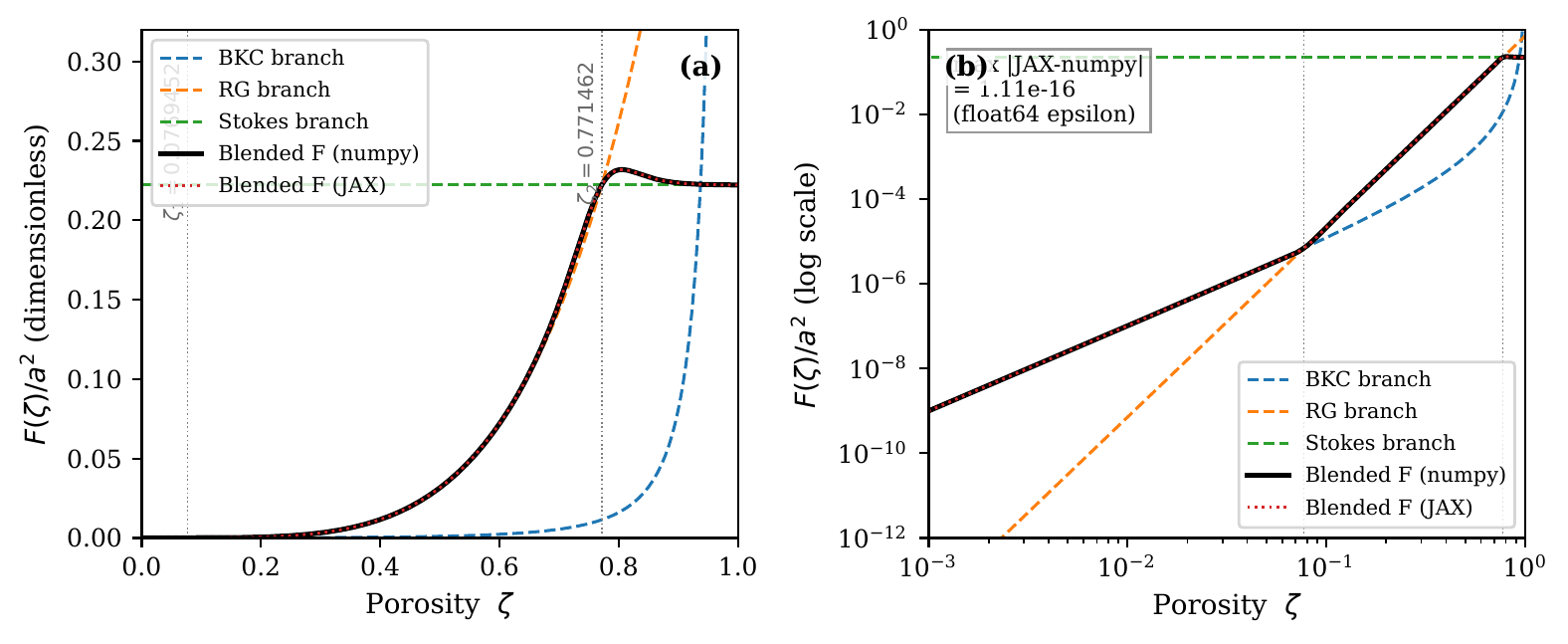
Figure 1. The gravitational-separation mobility \(F(\zeta) = K(\zeta)/\zeta\) (the permeability divided by porosity), shown as the dimensionless \(F(\zeta)/a^2\) against porosity. Dashed lines: the three regime branches considered individually, namely Blake-Kozeny-Carman (BKC), Rumpf-Gupte (RG), and Stokes settling, following Abe (1995)2 and Bower et al. (2018)3 §2.1. Solid black: the smooth tanh-blended composite that Aragog actually evaluates, with regime-switch porosities \(\zeta_1=0.0769452\) (BKC to RG) and \(\zeta_2=0.771462\) (RG to Stokes). (a) Linear axis showing the smooth crossover. (b) Log-log axis showing the BKC regime extending to vanishingly small porosity. The numpy and JAX implementations agree to within float-64 machine epsilon (\(\max|\Delta F|=1.1\times 10^{-16}\) in absolute units).
Phase-boundary smoothing
The smoothing function \(\mathrm{smth}(\phi)\) vanishes outside the mushy band, keeping the flux differentiable at the solidus and liquidus. Two forms are configurable:
phase_smoothing |
Formula |
|---|---|
"tanh" (default) |
SPIDER-style two-branch \(\mathrm{get\_smoothing}\) with width matprop_smooth_width = 0.01; \(\mathrm{smth}(g\phi) \approx 1\) across \([0.05, 0.95]\) and ramps to 0 in narrow skirts at the solidus and liquidus |
"cubic_hermite" |
\(\mathrm{smth}(g\phi) = 16\,g\phi^2(1 - g\phi)^2\) for \(g\phi \in [0, 1]\) (intermediate-\(\phi\) damping; fallback for residual EoS mismatch) |
Here \(g\phi\) is the un-truncated two-phase fraction at the staggered cell below the basic-node interface. Without smoothing, a raw \(\rho\phi(1-\phi)v_\mathrm{rel}\) flux drains the CMB cell off the EOS table edge in a single coupling step at first crystallisation.
Bottom-up gating
When bottom_up_grav_sep = true, a SPIDER-parity bottom-up gate disables \(j_\mathrm{grav}\) below the rheological transition until the solid fraction is interconnected.
Here "interconnected" refers to the standard porous-medium criterion: solid grains form a connected matrix that can support a self-consistent melt-percolation flow, which numerically corresponds to local melt fraction \(\phi < \phi_\mathrm{rheo}\) (the rheological critical melt fraction, default 0.4 in Aragog).
Above \(\phi_\mathrm{rheo}\), the solid is a dilute suspension and the gravitational-separation flux is suppressed by the smoothing function \(\mathrm{smth}(\phi)\); below it, the matrix is connected and percolation is permitted.
This prevents spurious upward percolation of the first solid grains and reflects the physics that melt cannot drain through a fully molten lower mantle.
Chemical mixing of melt fraction
Chemical mixing acts as a diffusive flux that relaxes the entropy gradient toward the local lever-rule prediction. The SPIDER-parity bracket form is
The bracketed expression is the entropy-gradient excess relative to the linear (lever-rule) interpolation between the solidus and liquidus entropy gradients at the local pressure. Outside the mushy band \(\mathrm{smth}(\phi)\) vanishes and so does the flux. The chemical eddy diffusivity \(\kappa_c\) is the same MLT diffusivity as \(\kappa_h\) scaled by eddy_diffusivity_chemical.
The term enters the entropy equation as a heat flux: even though the flux carries melt mass (not energy directly), the latent heat associated with the redistributed melt is what shows up in the energy budget at staggered nodes.
Internal heating
Internal heating contributes to the entropy equation through the source term \(\rho H\) in the integral balance. Two contributions are tracked; the radiogenic-decay model and the per-isotope configuration are discussed in Energy equation. Per-call energy integrals (step_dE_Q_radio_J, step_dE_Q_tidal_J) are documented in Energy diagnostics.
- Radiogenic. \(H_\mathrm{radio} = \sum_i \chi_i \varphi_i \exp(-\ln 2\,(t - t_0)/\tau_{1/2,i})\), time-dependent and (typically) space-uniform.
- Tidal. Per-staggered-node array supplied through
tidal_array; broadcast scalar or length-\(N\) array.
The volumetric work done when melt of different density is transported across a pressure gradient is not added as an explicit volumetric source. By definition the enthalpy contrast \(\Delta h = \Delta u + P\,\Delta v\), and on a hydrostatic column \(\partial \Delta h/\partial r \supset \Delta v\,\partial P/\partial r = -\rho g\,\Delta v\), so \(-\partial/\partial r(j\,\Delta h) \supset +\rho g\,\Delta v\,j\) already carries the same quantity through the divergence of the \(\Delta h\)-weighted mass-flux contributions to _heat_flux. Adding it explicitly would double-count (Bower et al. (2018)3 §3, SPIDER energy.c).
Per-component flux output
The basic-node flux contributions are exposed individually on SolverOutput:
| Field | Component |
|---|---|
jcond_b |
\(F_\mathrm{cond}\) |
jconv_b |
\(F_\mathrm{conv}\) |
jgrav_b |
\(F_\mathrm{grav}\) |
jmix_b |
\(F_\mathrm{mix}\) |
heat_flux |
\(F_\mathrm{tot}\) |
dSdr_b |
\(\partial S/\partial r\) at basic nodes |
Per-staggered-node heating is in heating (sum of the two contributions); per-component arrays are exposed via heating_radio and heating_tidal.
Decomposition on a fully-mushy state
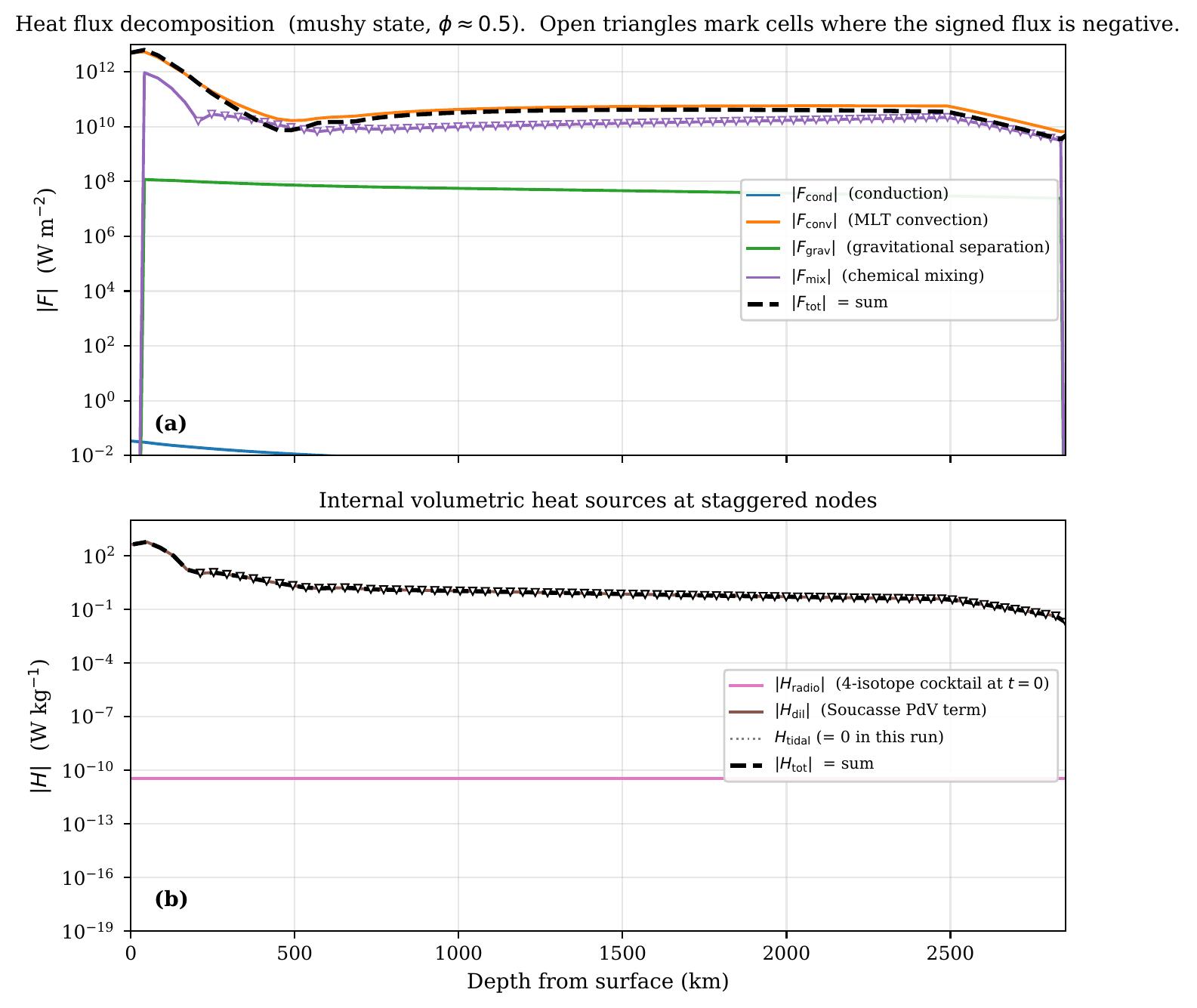
Figure 2. (a) Magnitude of the four heat-flux components \(F_\text{cond}\), \(F_\text{conv}\), \(F_\text{grav}\), \(F_\text{mix}\) and their sum on an 80-cell Earth mesh, evaluated at a fully-mushy state where the entropy on each cell is the midpoint of the local solidus and liquidus values plus a small surface-ward gradient. Open triangles mark cells where the signed flux is negative. The four components reconstruct \(F_\text{tot}\) to floating-point round-off (\(\max|F_\text{tot}-\sum F_i|/|F_\text{tot}| < 10^{-15}\)). (b) Internal volumetric heating sources \(H_\text{radio}\), \(H_\text{tidal}\) at the staggered nodes for the same state, with the bundled radionuclide cocktail at \(t=0\).
-
Yutaka Abe, Thermal evolution and chemical differentiation of the terrestrial magma ocean, Geophysical Monograph 74, AGU, 41–54, 1993. SciX. ↩
-
Yutaka Abe, Basic equations for evolution of partially molten mantle and core, in Yukutake, T. (ed.), The Earth's Central Part: Its Structure and Dynamics, Terra Sci. Pub. Com., 215–230, 1995. ↩↩↩
-
D. J. Bower, P. Sanan, A. S. Wolf, Numerical solution of a non-linear conservation law applicable to the interior dynamics of partially molten planets, Physics of the Earth and Planetary Interiors, 274, 49–62, 2018. SciX. ↩↩↩↩