Tutorial: run a system standalone
This runs one system of six embryos from a settings file, in under a second, and reads the result. It needs Morrigan installed and nothing else; see installation if you have not done that yet.
The settings file
Save this as tutorial.toml:
['run_simulation']
# Bookkeeping the driver expects; leave these four as they are.
t = 0.0
t_ref = 0.0
t_event = 0.0
flag_event = 1

a_min = 0.005            # perihelion inside which a body is lost to the star [AU]
max_time = 0.5           # evolution time [Gyr]
save_directory = 'tutorial_run'
random_seed = 7          # fixing this reproduces the run exactly

['batch']
ndisk = 1                # one system, so the output is easy to read
nproc = 1

['init_par']
N = 6                    # six embryos
e = 0.01                 # shared initial eccentricity
Mp = [0.4, 0.8, 0.5, 1.0, 0.6, 0.7]   # embryo masses [M_earth]
impact_angle = 45        # [deg]

Ms = 1                   # stellar mass [M_sun]
rho_p = 5500             # bulk density [kg m-3]
inner_edge = 0.3         # innermost embryo [AU]
The section header on the first line is required: the driver reads its settings
from ['run_simulation'], and a file without it stops with a KeyError. Every
field is described in settings and inputs.
Run it
$ morrigan -c tutorial.toml
Writing results to /path/to/tutorial_run
Ran 1 system in 0.04s
Four files appear under tutorial_run:
| Path | Contents |
|---|---|
data/full_systems/full_system_00.csv |
every body's orbit and mass through time |
data/mergers/mergers_00.csv |
one row per collision |
data/survivors/survivors_00.csv |
what was left at the end |
batch_summary.csv |
runtime and surviving-body count |
What this system does
Six embryos between 0.30 and 0.52 AU go unstable early. Four collisions occur, all within the first 190 000 yr, and two bodies survive:
| Time [yr] | Target | Impactor | Target before [M⊕] | Merged after [M⊕] |
|---|---|---|---|---|
| 60 120 | 1 | 0 | 0.80 | 1.20 |
| 82 458 | 4 | 2 | 0.60 | 1.10 |
| 90 025 | 4 | 3 | 1.10 | 2.10 |
| 187 332 | 4 | 1 | 2.10 | 3.30 |
| id |  Mp [kg]    | a_AU   | ecc   |
|  4 | 1.97129e+25 | 0.3335 | 0.074 |
|  5 | 4.18152e+24 | 0.7394 | 0.394 |
Body 4 grows from 0.60 to 3.30 M⊕ in three collisions and settles at 0.33 AU on a nearly circular orbit. Body 5 never collides: it is scattered from 0.52 AU out to 0.74 AU and left with an eccentricity of 0.39, which is what a system does to the body that survives without merging.
The result
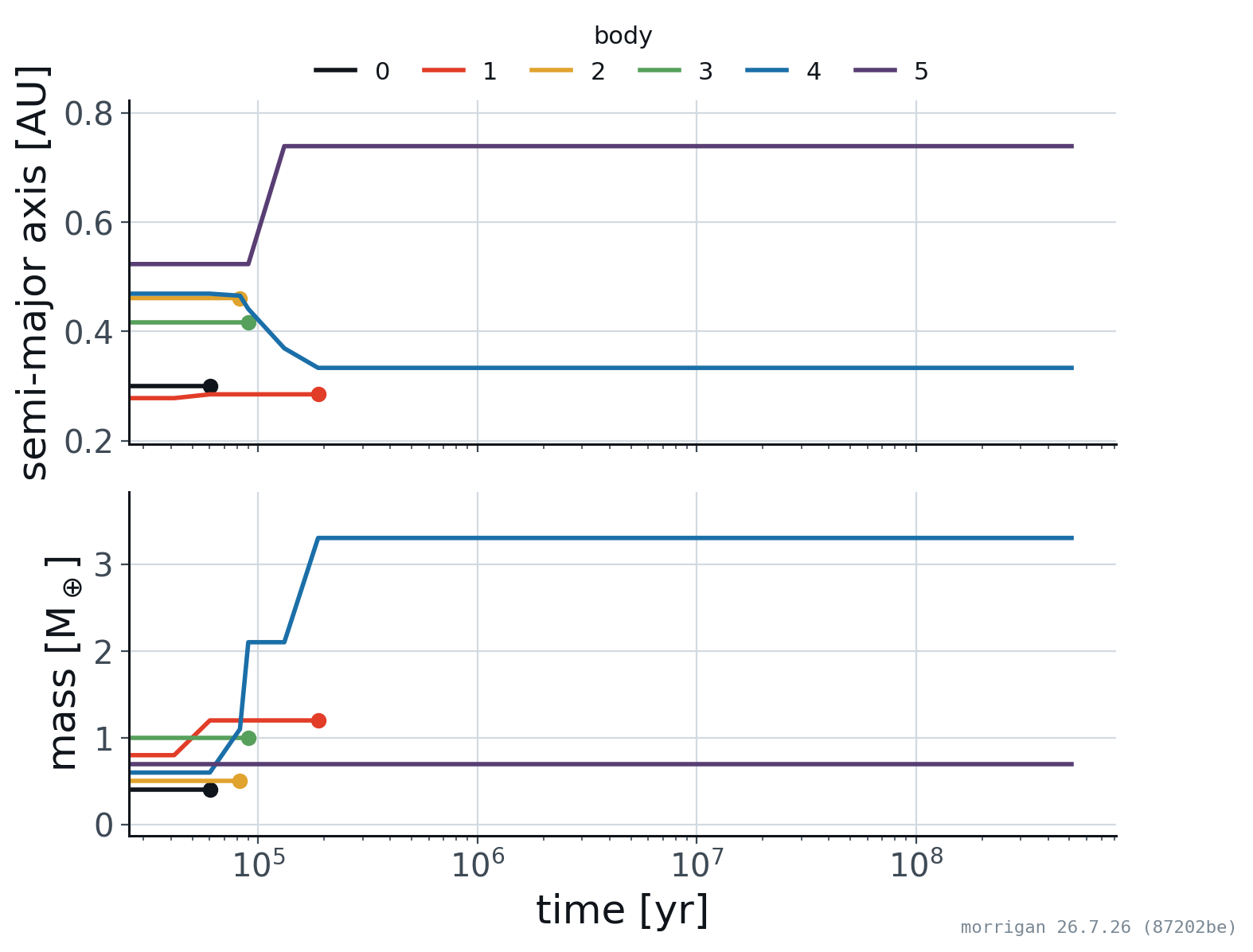
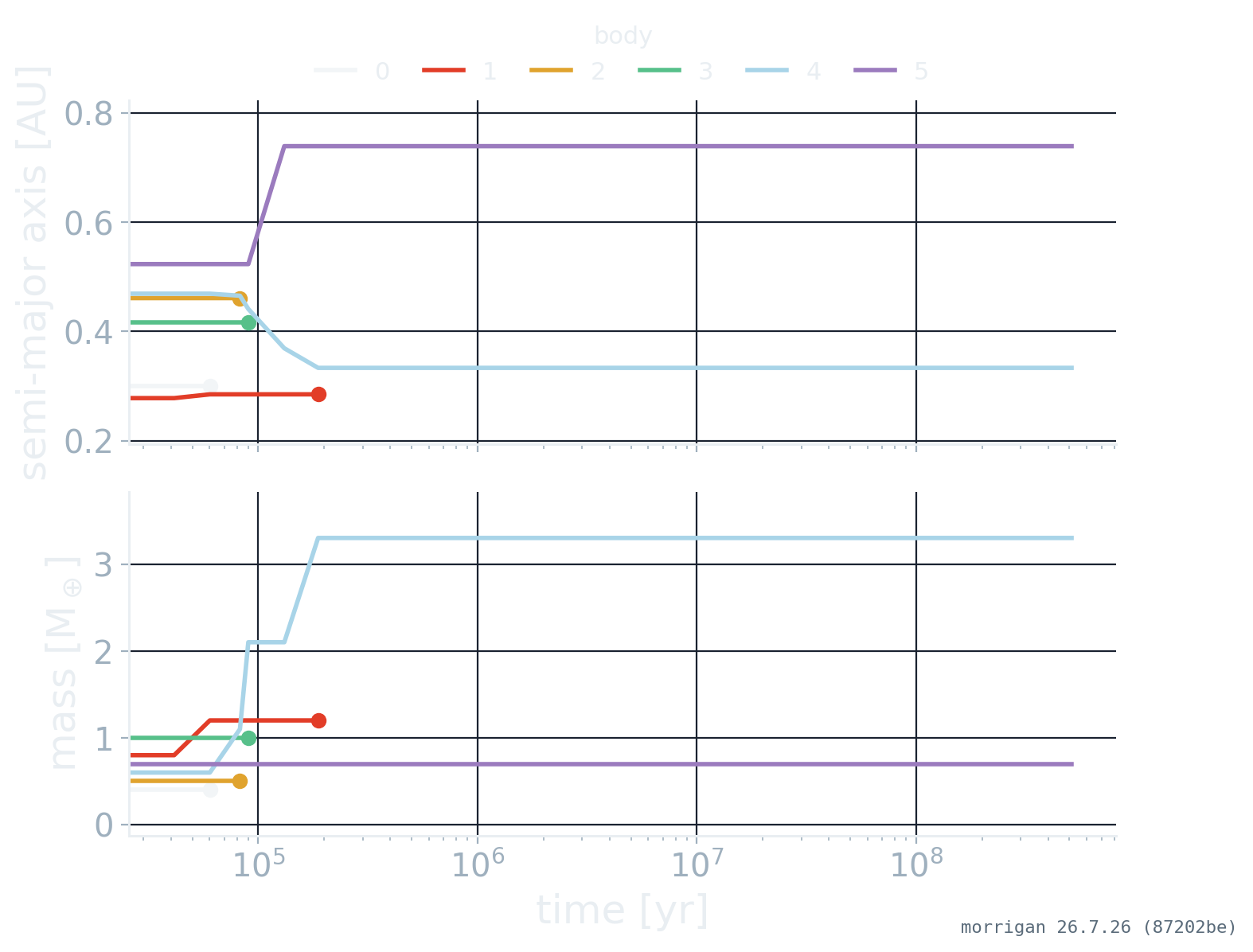
Two things are worth reading off it. The whole giant-impact phase is over within the first fraction of a percent of the evolution time, which is why the tracks are flat across most of a logarithmic axis: once the system is Hill-stable nothing further happens, and running longer changes nothing. And the mass that body 4 gains is exactly the mass the other tracks lose, because a collision in this model is a perfect merger.
The figure above is drawn by tools/plot_tutorial.py in the repository. The
plot.py script at the repository root plots a whole batch instead, with
per-system tracks, orbits and ensemble statistics:
$ pip install -e ".[plot]"
$ python plot.py -c tutorial.toml
What to change next
random_seedsamples a different realisation of the same initial conditions. One seed gives one history, bit for bit; the spread across seeds is the meaningful quantity, not any single run.NandMpset how much material the system has and how it is divided.inner_edgemoves the whole system in or out, which changes the collision speeds and the instability time.ndiskin['batch']runs many systems on a process pool for the statistics.
Choosing the initial conditions covers how spacing and eccentricity set the instability time, which is what decides whether a run has any collisions at all.
Next
- Run Morrigan inside PROTEUS with a complete configuration file.
- Model overview for the physics behind these tracks.
- Limitations for what this model does not represent.