
 PROTEUS
 Early Earth
At a glance
| Mass | 1 MEarth |
| Orbit | 1 AU (Sun) |
| Volatiles | 1 Earth ocean H2O |
| Redox | IW+4 |
| Interior | SPIDER (magma ocean dynamics) |
| Atmosphere | AGNI (radiative-convective) |
Detailed interpretation
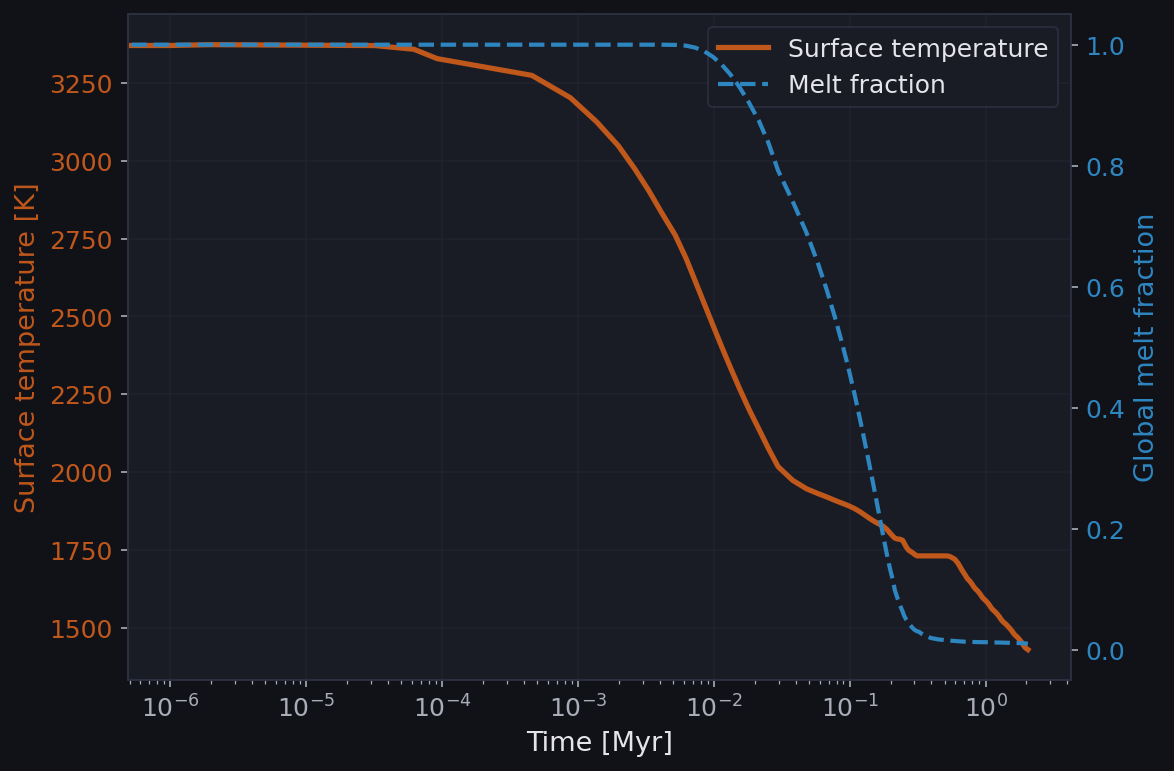
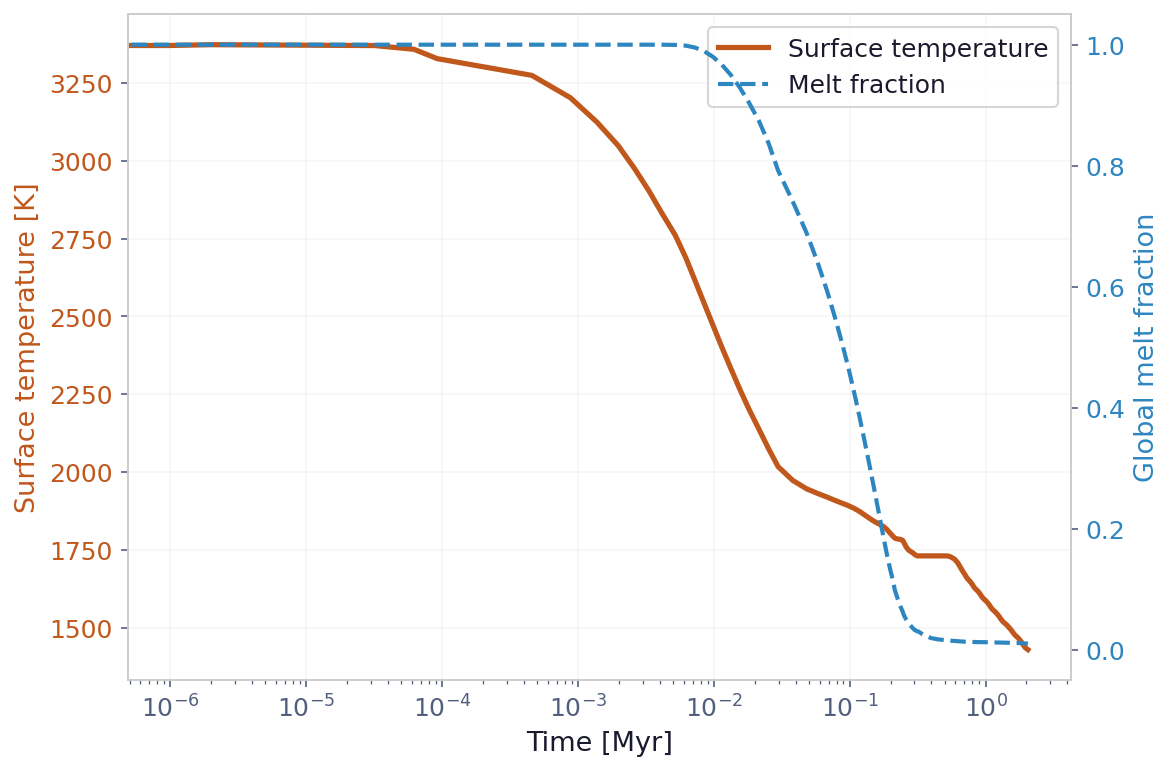
Starting from a fully molten mantle after a giant impact, PROTEUS tracks how Earth's magma ocean solidifies and volatiles outgas to form a thick steam atmosphere.
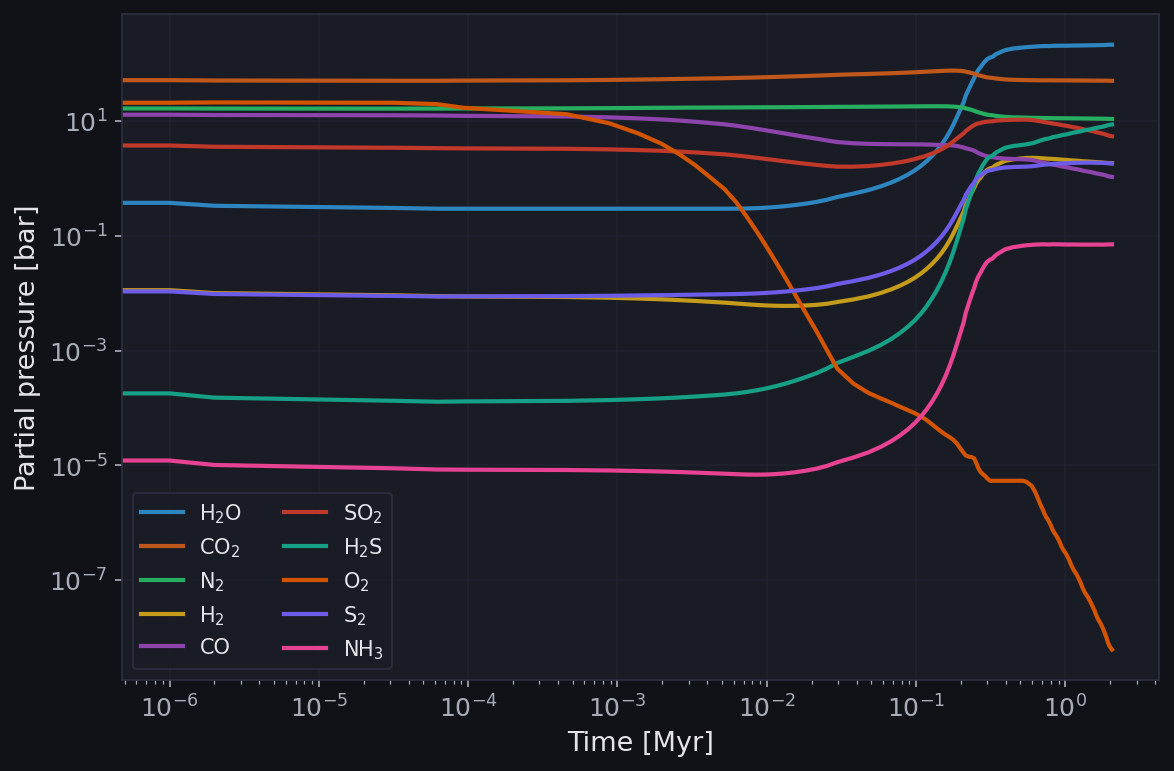
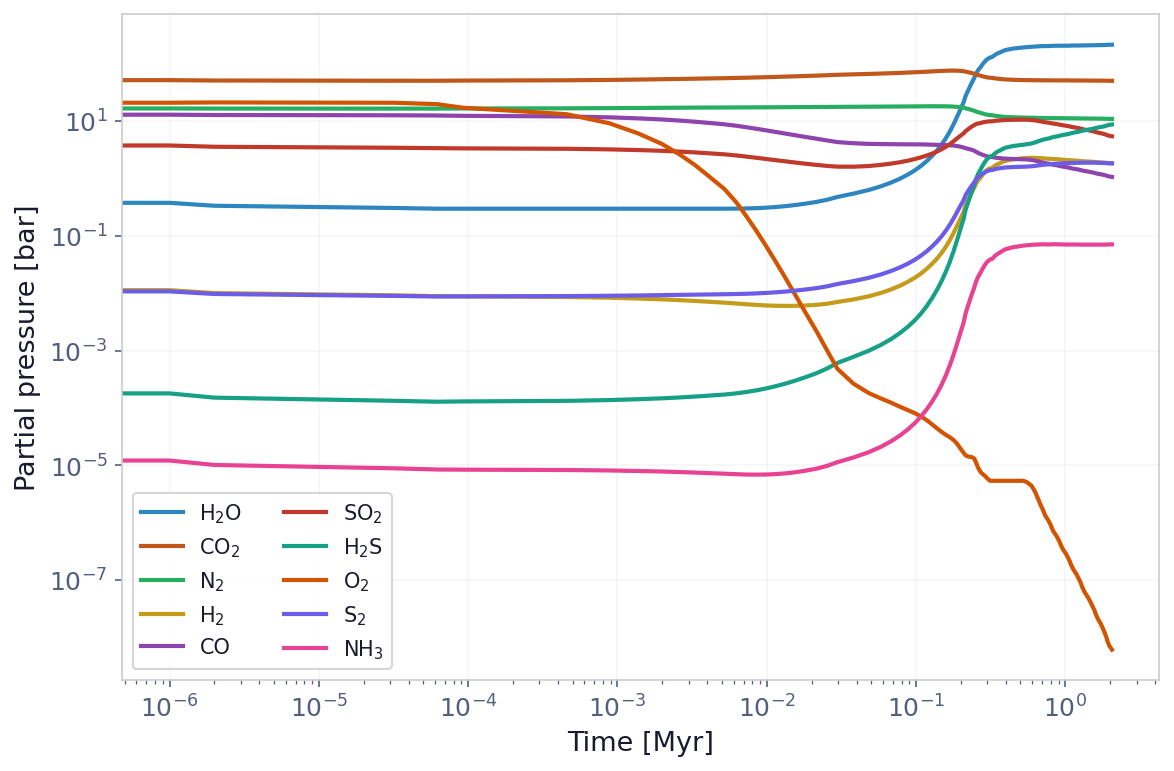
The simulation begins with a high mantle entropy (2900 J/K/kg) representing the aftermath of the Moon-forming impact. As the magma ocean cools, dissolved volatiles partition into the atmosphere following thermochemical equilibrium (CALLIOPE). The atmosphere becomes dominated by H2O, CO2, and sulfur species.
The surface cools from ~3400 K to ~1400 K within the first ~2 million years, with the last few percent of deep-mantle melt persisting through rheological transitions. By the end of solidification the atmosphere has grown to ~290 bar (~210 bar H2O, ~50 bar CO2, plus N2, H2S, and SO2). This thick steam atmosphere eventually condenses to form a liquid water ocean beneath a CO2-dominated atmosphere, constraining when Earth first became habitable.
Beyond Earth
The same physics that governed early Earth applies across a wide range of exoplanets. PROTEUS is designed to model any rocky or volatile-rich world, from lava planets orbiting their stars in hours to sub-Neptunes with thick hydrogen envelopes.
Super-Earths like L 98-59 d (1.6 Earth masses, orbiting an M-dwarf at 0.05 AU) experience intense stellar irradiation and tidal heating from neighbouring planets. These effects can sustain partially molten interiors for billions of years, producing thick outgassed atmospheres that JWST is beginning to characterize. Lava worlds, even closer to their host stars, maintain permanent magma oceans with thin silicate atmospheres that glow in thermal emission. Sub-Neptunes, the most common planet type in the Galaxy, sit at the boundary between rocky and gaseous worlds: their final atmospheric mass is set by a competition between interior outgassing and XUV-driven escape, both of which PROTEUS tracks self-consistently.
Demonstrations for these scenarios are in preparation. For the underlying science, see our publications.
What PROTEUS computes
Each simulation couples multiple physical processes in a single self-consistent calculation: radiative transfer through the atmosphere, convective heat transport in the mantle, thermochemical partitioning of volatiles between melt and gas, stellar evolution, and atmospheric escape. The modules responsible for each process can be swapped independently; see the modules page for details.
The outgoing radiation spectra shown in the animation are computed at every time step by the atmosphere module (AGNI), producing synthetic observables that can be compared directly with telescope data from JWST and future missions.